
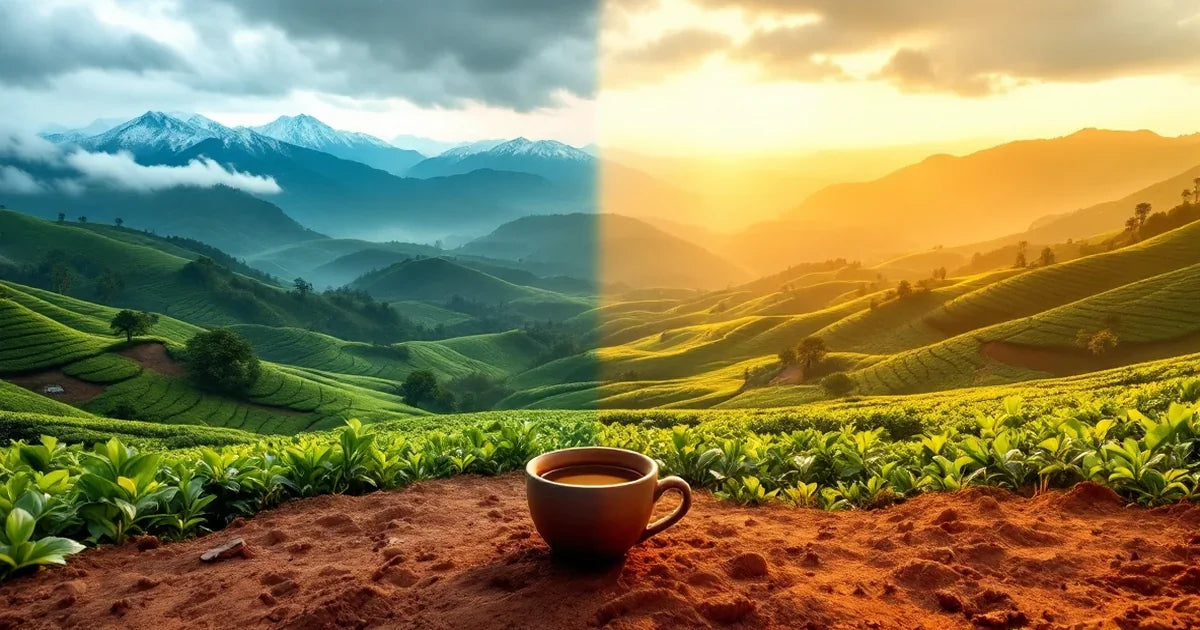
Tea cultivation in India began as a commercial project in the 1820s and 1830s, after British officials learned from the Singpho people that tea already grew and was used in Assam. The British East India Company pushed that knowledge into plantation agriculture, and the Assam Tea Company, founded in 1839, turned Indian tea into a large-scale industry. The three regions that came to define Indian tea were Assam, Darjeeling, and Nilgiri.
The history of tea in India begins with a contradiction. India is now one of the world's defining tea countries, yet the cup the British wanted was not Indian at all. For decades, East India Company tea meant tea bought from China, shipped to Britain at enormous cost, and tied to a widening trade deficit the empire wanted to escape.
Then Assam changed the story. Wild tea was already growing in northeast India, local communities had been drinking it for generations, and colonial officials slowly realized they were looking at a plant that could redraw the global tea map. What followed was not a gentle agricultural tale. It was a story of indigenous knowledge, imperial ambition, botanical theft, plantation labor, factory innovation, and finally the everyday cup of chai.
Wild tea in Assam, before the British story began
Long before tea became an export commodity, Camellia sinensis var. assamica grew wild in the humid forests of Assam. This was not the small-leaf China type that British botanists already knew. It was a larger, more vigorous tea plant adapted to heat, rain, and lowland conditions. Put differently, a tea built for the Brahmaputra valley.
The Singpho people knew that well. They had been using and drinking the leaf before Europeans entered the picture, sometimes as a prepared beverage, sometimes in forms that looked quite different from the refined teas shipped out of Chinese ports. British accounts often say Robert Bruce "discovered" the Assam tea plant in 1823. That is the colonial version of the story. The plant was not waiting to be discovered. It was already part of local life.
What Bruce did was carry that knowledge into the machinery of empire. Reports moved from Assam to Calcutta. Botanists compared specimens. Officials argued over whether the plant was truly tea or only a close relative. Once they confirmed that it was indeed tea, everything changed. The British were no longer limited to buying leaf from China. They had found a tea frontier inside their own colony.
The East India Company and the push for Indian tea
To understand why that mattered, you have to look east. Britain had built a national habit around Chinese tea, but that habit was expensive. Silver flowed out. Dependence deepened. The East India Company wanted a way out of China's tea monopoly, and the search for Indian tea became part of a much larger commercial strategy. We tell the Chinese side of that story in our article on the history of tea in China.
Assam offered an opening, but not a finished industry. The first step was to turn wild or semi-wild tea into something plantation agriculture could control. Experimental gardens appeared in the 1830s, and in 1839 the Assam Tea Company was founded, creating the first large commercial tea estates in India. This is the moment when tea stopped being only a botanical curiosity and became capital, acreage, transport, labor, and scale.
The British still had another problem: they knew China produced finer processed tea than their early Indian experiments. So they went after Chinese know-how as well. In 1848, the botanist Robert Fortune traveled into Chinese tea districts, collected plants and seeds, and carried back not only living material but practical knowledge about cultivation and manufacture. The project is often described politely as plant transfer. In reality, it was industrial espionage in botanical form.
That theft mattered, but so did the plant itself. India did not become a tea giant simply by copying China. It had its own tea variety in Assam, and the British gradually learned that the large-leaf Assam type and the smaller China type behaved differently in the field and in the cup. The Assam plant gave body, depth, and vigor in hot climates. China-type plants often performed better in cooler mountain districts. If you want the botanical background, our guide to Assam vs China tea varieties explains how those family traits still shape tea today.
By the middle of the nineteenth century, the direction was set. Tea in India would not be a side project. It would be an imperial industry designed to break China's hold on the British market, feed metropolitan demand, and turn Indian land into a new tea engine for the world.
Darjeeling, Nilgiri, and the spread of plantations
Once the plantation model proved workable in Assam, tea moved. It climbed into the Himalayan foothills, spread into southern highlands, and attached itself to new landscapes with surprising speed. Tea estates remade hills, forests, roads, and labor systems. By the late nineteenth century, India was no longer an experiment. It was a tea powerhouse.
Assam, lowland strength
Assam remained the engine room. The valley's hot, wet climate suited the large-leaf Assam plant, and the resulting tea developed the strong, malty profile still associated with the region. This is the black tea that feels broad in the mouth, dark in the cup, and sturdy enough for milk. Even now, when people think of a full breakfast blend, they are often thinking of Assam whether the label says so or not.
Assam's importance was also structural. River transport on the Brahmaputra, British land grants, and the expansion of factory manufacture turned the valley into the place where Indian tea could be produced at scale. That scale came with a harder truth: the estates needed far more labor than local communities were willing to supply under plantation terms, which pushed the industry toward recruited and contracted workers from other parts of India.
Darjeeling, altitude and lift
Darjeeling took tea in the opposite direction. Up in the cool Himalayan air, many gardens worked with China-type material, and the cup became lighter, more aromatic, and more transparent. Spring teas could feel green, floral, almost shimmering. Summer harvests deepened into the fruitier, muscatel profile that made Darjeeling famous. If Assam built its reputation on weight, Darjeeling built its own on fragrance and altitude.
The first serious plantings in Darjeeling belonged to the 1840s and 1850s, when British officials tested China-type tea in the Himalayan foothills. The setting changed the leaf. Cool air, steep drainage, mist, and slower growth made Darjeeling less useful as a volume engine and more valuable as a place-specific tea, a reputation that would later make legal protection necessary.
Nilgiri, the quiet southern range
Far to the south, the Nilgiri hills developed another expression of Indian tea. The region's elevation and milder climate allowed for production through much of the year, and the cup often came out clean, balanced, and bright rather than heavy. Nilgiri rarely receives the mythology attached to Assam or Darjeeling, but it became an important part of India's tea map precisely because it was so reliable.
Nilgiri also gave Indian tea a southern anchor. While Assam and Darjeeling carried the louder colonial and export narratives, Nilgiri supplied dependable black tea, orthodox leaf, and later specialty lots shaped by winter conditions. Its best cups can feel brisk and fragrant without the weight of Assam or the delicacy of Darjeeling, which is part of why blenders valued it.
Together, these regions gave India range. Malty lowland tea, high-grown perfume, southern clarity. A single country, but not a single cup. Our broader guide to types of black tea shows how these regional styles sit beside one another in the global black tea family.
Plantation labor and the human cost
Indian tea grew through plantation labor, and that labor history cannot be separated from the cup. Assam's estates were built in a region where many local communities resisted plantation work, so planters and recruiters drew workers from central and eastern India under harsh contracts. The result was not just migration. It was a new labor system tied to debt, distance, surveillance, and limited freedom.
The British legal structure made that system durable. Earlier inland emigration laws had already regulated the movement of recruited workers into Assam, and the Inland Emigration Act of 1882 tightened the contract regime that bound laborers to plantations. On paper, these rules organized recruitment and employment. In practice, they helped estates hold a workforce that could not easily leave, even when wages, housing, sanitation, and discipline were punishing.
Assam tea therefore carries two histories at once. One is the botanical and commercial history of a native tea plant becoming a global commodity. The other is the history of Adivasi and other migrant communities whose descendants became the tea tribes of Assam, with their own languages, festivals, political struggles, and claims to dignity. We cannot respect the leaf while leaving that labor as background scenery.
Maniram Dewan makes that tension visible in one life. He worked with the Assam Tea Company, became one of the first Indian tea entrepreneurs in Assam, and established his own tea gardens in the 1840s. He also fell into conflict with British power and was executed in 1858 after the 1857 uprising. His story reminds us that Indian participation in tea was never only labor at the bottom or empire at the top. There were Indian cultivators, brokers, critics, rebels, and entrepreneurs inside the history from early on.
CTC and the democratization of tea
The next big change was not about geography. It was about machinery. In the 1930s, CTC, short for Crush, Tear, Curl, was developed for the needs of Indian tea manufacture, especially in Assam. Instead of preserving an elegant whole leaf, the process broke the leaf into small particles designed to brew quickly, strongly, and consistently. It was efficient, modern, and perfectly suited to a mass market.
That altered the social life of tea. CTC tea stood up to milk. It stood up to sugar. It stood up to hurried brewing in homes, canteens, stations, and roadside stalls. If orthodox black tea often asks for attention, CTC asks only for boiling water and a few minutes. For a closer look at the mechanics behind it, our article on how black tea is made traces the processing logic in more detail.
It also helped create modern chai culture. Strong black tea simmered with milk, sugar, and often ginger, cardamom, cinnamon, or clove became an everyday drink rather than a luxury import. The form mattered. Broken tea released flavor fast, which meant vendors could build a satisfying cup at street speed. Tea moved out of export warehouses and into railway platforms, office breaks, home kitchens, and neighborhood corners.
This is one of the most important turns in India's tea story. The industry had been built to serve Britain, but tea eventually became woven into Indian daily life on its own terms. Not just estate tea for foreign buyers. A domestic habit. A national rhythm.
Chai, the cup that became Indian
Masala chai was not invented by one person on one date. It grew from older South Asian habits of simmering spices, herbs, milk, and sweeteners, then changed when black tea became cheap enough to enter ordinary kitchens and stalls. That is the honest answer to "who invented chai": no single inventor, but many drinkers, vendors, railway workers, and households adapting tea to local taste.
Before colonial tea became common, spiced drinks already had a place in domestic and household traditions. Ginger, cardamom, cinnamon, clove, pepper, and other aromatics were not decorative flavorings dropped onto a British beverage. They belonged to an older vocabulary of warmth, hospitality, and everyday comfort. When black tea entered that vocabulary, it did not stay British for long.
CTC made the change practical. A small amount of broken Assam-style tea could survive boiling, milk, sugar, and spices, giving the cup enough tannin and color to feel complete. That is why modern chai belongs as much to processing history as to kitchen history. Without fast-brewing broken tea, the street-side version would have been harder to make at speed and price.
By the early twentieth century, tea promotion followed people into workplaces, railway stations, and canteens. From the 1900s through the 1940s, station tea and vendor tea helped normalize the small, hot, sweet cup that travelers could drink standing up. After independence, the Tea Board of India continued the domestic push through campaigns often remembered under slogans such as "Try Tea," and by the 1950s to 1970s tea had settled into a daily habit across class, region, and language.
The chaiwalah matters here. A roadside or platform tea seller is not a minor character in Indian tea history; he is one of the people who made tea social, portable, and democratic. In the hands of chaiwalahs, tea was no longer only an estate product, an auction lot, or an export commodity. It became a conversation held in a glass.
Darjeeling's geographical indication and what it protects
Darjeeling's geographical indication protects a place, not just a flavor word. In 2004, Darjeeling tea became India's first GI-protected product, giving legal force to a name that had already been traded globally for more than a century. The protection matters because "Darjeeling" had become valuable enough to misuse.
True Darjeeling tea comes from defined gardens in the Darjeeling hills, grown roughly between 600 and 2,000m above sea level and traditionally centered on China-type Camellia sinensis var. sinensis. The GI is meant to protect that combination of origin, altitude, plant material, processing, and garden identity. A tea can imitate the fragrance, but it cannot become Darjeeling by style alone.
The commercial problem is simple. Darjeeling produces only a small amount of tea compared with Assam: recent annual production is around 6 to 7 million kg, with 2023 output near 6.3 million kg after a multiyear decline, while far more tea is sold worldwide as "Darjeeling" than the gardens actually produce. That gap created room for blending, relabeling, and loose use of the name in markets far from the hills.
GI protection does not make Darjeeling easy. The region still faces climate stress, aging bushes, estate economics, labor disputes, and competition from nearby teas that can taste similar. What the GI does is draw a line around origin. It tells the buyer that Darjeeling is not only a muscatel note or a poetic label. It is a set of gardens, slopes, workers, seasons, and legal obligations.
Indian tea today, global in scale and local in habit
That older history still shapes the present. According to Tea Board India's recent annual statistics, national production has reached approximately 1.3 to 1.4 million metric tons annually, keeping India second only to China in total output. Assam still accounts for about half of that volume, which tells you how enduring the original tea frontier remains. The old center still matters.
The 2023-24 Tea Board figures make that scale more concrete: India produced roughly 1.37 to 1.39 million metric tons of tea in 2023-24, with about 1.1 billion kg available for domestic consumption after imports and exports are counted. In ordinary language, most Indian tea is drunk in India. The export story still matters, especially for markets such as Russia, the United Kingdom, the United Arab Emirates, and the United States, but the home market is the center of gravity.
Darjeeling tells the opposite story. Its production is tiny beside Assam's, yet its prestige is enormous. The name carries global recognition, and its geographical indication protection matters because Darjeeling's value has always depended on place: mountain air, specific gardens, and a flavor no flatland factory can reproduce by imitation.
What may be most striking, though, is where the tea goes. Most Indian tea now stays in India. Roughly four-fifths of national production is consumed domestically, which means the country is no longer defined only as an exporter. It is also one of the world's great tea-drinking societies, where tea is woven into work, travel, hospitality, and everyday pause.
At the same time, Indian tea is not only mass CTC. Orthodox production has been revalued in Assam and the Nilgiri hills, second-flush Darjeeling still commands attention from buyers who care about season and garden, and Nilgiri frost teas show how a familiar region can produce a more focused winter cup. These are smaller streams beside the river of everyday chai, but they matter because they keep Indian tea from being flattened into one industrial style.
Sustainability now sits inside that question of value. Some estates work with Rainforest Alliance certification, organic certification, or biodynamic and organic programs in Darjeeling, partly for export markets and partly because soil, slope, rainfall, and labor pressure cannot be ignored forever. Certification is not a solution to every problem in the tea economy. It is one visible sign that the next chapter of Indian tea has to account for land and people as much as yield.
And the story did not stop at India's borders. The plantation model built under British rule spread onward to places such as Sri Lanka, reshaping another island economy and another tea culture in its wake. That next chapter is part of the history of tea in Sri Lanka. For the other side of the trade — how Indian and Ceylonese teas gradually displaced Chinese teas in British homes and how tea shaped European and American history — our piece on the history of tea in Europe and America covers that arc.
From our perspective at FETC, Indian tea history is never only about one leaf. It is about what happens when botany, commerce, empire, and ordinary drinking habits collide. A wild plant in Assam. A colonial trade problem. A mountain garden in Darjeeling. A station-side cup of chai.
That is why the history of tea in India still feels alive in the cup. You can taste it in Assam's weight, Darjeeling's lift, Nilgiri's clarity, and in the everyday strength of milk tea across the country. Not one tea story, but many, pressed into a single nation and still unfolding.