
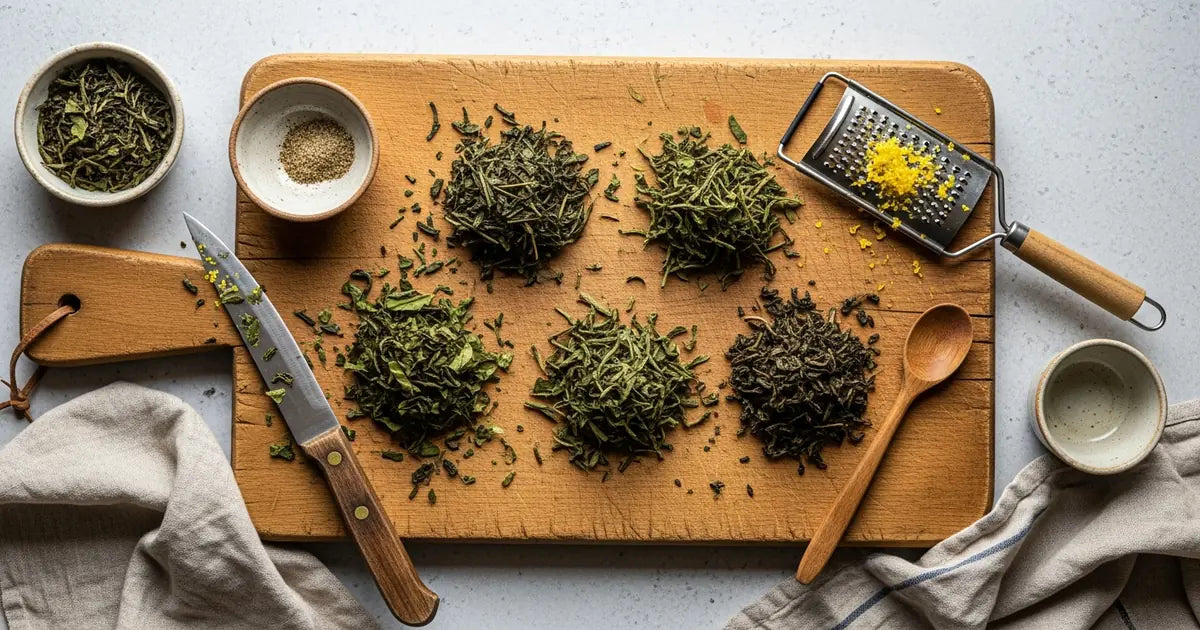
Morning tea leaves a small pile of damp green in the strainer, still fragrant, still soft, still carrying something of the cup. It is easy to throw them away without a second thought. But if you have ever wondered what to do with used tea leaves, start there. Some of the most practical uses for green tea leaves begin after brewing, not before. Our team reuses plain, unsweetened leaves in the kitchen, around the house, and in a few quiet body-care rituals too. One brew. More than one life.
In the kitchen
Food is often the best answer to used green tea leaves. The liquor may have taken much of the bitterness and caffeine, but the leaf itself still offers texture, aroma, and nutrients. Especially with a whole-leaf tea such as Sencha, the spent leaf is often tender enough to cook with right away.
Ohitashi, a simple Japanese side dish
This is one of the most satisfying ways to reuse brewed leaves. In Japan, used green tea leaves are sometimes turned into ohitashi, a lightly seasoned vegetable side dish. The method is modest: blanch the used leaves very briefly if you want a softer texture, squeeze out excess water, then dress them with a little soy sauce and scatter bonito flakes on top. Sesame works well too.
The flavor is gentle. Less like a fresh salad, more like a quiet, savory condiment you can serve beside rice. If you want the exact method, our ohitashi recipe walks through it in detail. For many tea drinkers, this is the clearest proof that brewed leaves are not finished just because the cup is empty.
Add to rice or noodles
Used tea leaves slip easily into everyday starches. Finely chop them and stir them into freshly cooked rice, or add them to the pot during the last stage of cooking for a soft, understated green aroma. The effect is subtle, not loud. More background than centerpiece.
Noodles work the same way. Mixed into warm soba, scattered over udon, or folded into cold noodles with sesame and soy sauce, the leaves add a faint vegetal note and a little texture without making the dish heavy. If the leaves are very wet, squeeze them first so they do not water down the seasoning.
Make a simple seasoning powder
Dry the used leaves slowly in a pan over low heat, stirring occasionally until all the moisture is gone. The process takes around five to seven minutes. Once dry, the leaves can be crumbled into a coarse powder and mixed with sesame, dried bonito flakes, and a pinch of salt. Scattered over rice or stirred into a bowl of noodles, it adds a quiet, savory depth without any sharp edge.
Hojicha leaves work particularly well here because the roasted note carries through the drying step. Store the finished powder in a small jar and use within a few days. It is the simplest way to move used green tea leaves from the strainer to the table with almost no extra effort.
Blend into smoothies
If you already make smoothies, used green tea leaves are easy to hide in the blender. The first infusion has removed much of the sharper edge, so the flavor sits more quietly behind fruit, yogurt, or milk. Banana, apple, pear, and honey all soften the leaf further.
This approach also makes sense nutritionally. Even after brewing, the leaf still contains fiber, chlorophyll, and some remaining minerals and tea compounds. You are not extracting from the leaf anymore. You are consuming the leaf itself. Start with a small spoonful and build from there. The goal is a gentle green note, not a slurry of wet leaves.
Around the house
Beyond the kitchen, used green tea leaves can work quietly in other parts of the home. Dried leaves absorb odors in the shoe cabinet or fridge. Damp leaves help gather dust during sweeping. And the tannins in spent tea can assist with light surface cleaning without any detergent.
Deodorizer
Dried used tea leaves can absorb odors naturally, which makes them useful in places where smells collect and stay. A small dish in the fridge, a sachet in the shoe cabinet, or a pouch tucked into a closet can take the edge off stale air. The aroma is not perfumed. Just faintly clean.
Drying matters here. Spread the leaves out on a tray, let them air-dry fully, or dry them gently in low heat before using them in enclosed spaces. If they remain damp, they can sour instead of freshen. Once fully dry, replace them every few days as needed.
Cleaning agent
There is an old Japanese habit of using damp tea leaves to help gather dust while sweeping. Scattered lightly over a floor, they catch fine particles instead of letting them rise back into the air. It is a small trick, but a clever one. Especially on surfaces that tend to send dust drifting.
Used leaves can also help with light kitchen cleaning. Rubbed gently over a greasy stovetop or counter, they provide mild abrasion and a little help from the tannins in the leaf. We would keep this for everyday mess, not delicate materials, and always wipe with water afterward. Still, it is one more answer to the question of what to do with used tea leaves when cooking is done.
Compost and garden fertilizer
The garden is one of the easiest places to send spent leaves. In compost, they add nitrogen and moisture to the pile, and they break down readily when mixed with drier material such as paper, straw, or fallen leaves. As always, balance matters. A thick wet layer by itself can compact and turn stale.
You can also work small amounts directly into soil around acid-loving plants. The effect is modest, but it fits naturally into a regular routine of feeding the garden. If you grow tea plants yourself, our guide to fertilizers for tea plants explains that balance in more detail. Used tea leaves are not a cure for everything the soil needs. They are simply one more organic material worth returning to it.
For your body
Spent tea leaves have a few gentle uses in personal care. A cloth bag of leaves dropped into the bath releases a quiet, earthy aroma. Cooled tea bags can rest over tired eyes. And used leaves mixed with honey make a simple scrub that is softer than most commercial exfoliants. All of these work best with plain, unsweetened tea and a small amount of patience.
Bath soak
Used green tea leaves can be tied into a thin cloth bag and dropped into a hot bath. As the water moves through them, the aroma softens and spreads. Not the bright scent of a fresh cup, but something quieter and greener. Many people also like the way tea baths leave the skin feeling a little softer afterward.
This is one of the easiest body uses because the preparation is minimal. Tie the leaves inside the cloth bag, knot it securely, and let it steep in the bath as if you were making an oversized infusion. When you are finished, the leaves can go straight to compost.
Eye compress
If your tea was brewed in bags rather than loose leaf, a cooled used tea bag can be laid over closed eyes for a few minutes. The tannins in tea create a tightening sensation on the skin, which is why this home remedy is often used for mild puffiness. It is a small ritual, but a familiar one.
Keep it plain and clean. Unscented tea only, well cooled, and not on irritated skin. If you brew loose tea, place the used leaves in a clean cloth pouch instead. The effect is more about comfort than transformation. Still, on a tired morning, comfort goes a long way.
Face scrub
Used tea leaves also make a gentle scrub when mixed with honey. The leaves provide soft texture, the honey helps it glide smoothly, and the result is milder than many harsh exfoliants. If the leaf pieces are long, chop them first so the mixture feels smoother on the skin.
Our team would keep this kind of use simple and cautious. Test a small area first, and use only leaves from plain tea with no sugar, milk, or flavoring. What makes it appealing is precisely that it does not need much. Just the brewed leaf, one kitchen ingredient, and a few quiet minutes at the sink.
For your things
Used tea leaves can also find a place in household crafts and maintenance. Simmered long enough, they produce a gentle natural dye for fabric. Damp leaves can polish unfinished wood. And a brief wrap of spent leaves can help prepare meat before cooking by loosening surface proteins.
Fabric dye
Simmer a pot of used tea leaves long enough and the water turns into a natural dye bath. The color is usually soft beige to light tan rather than a deep brown, which makes it well suited to cotton, linen, small cloth napkins, or wrapping fabric. The beauty of tea dye is its restraint. Nothing loud. Just a muted, lived-in tone.
Because the leaves have already been brewed once, the shade will be gentle. If you want more depth, build up the color with repeated soaks or combine several batches of spent leaves over time.
Wood polish
Damp used tea leaves can be rubbed lightly over unfinished wood to lift dust and leave a slight sheen behind. It is a small, old household trick, not a replacement for proper wood treatment, but on simple untreated surfaces it can give the grain a softer look.
We would keep this away from lacquered finishes, antiques, or anything delicate. Test a small area first. On the right surface, though, the method is pleasingly direct: leaf, hand, wood. One natural material touching another.
Meat tenderizer
This one circles back to the kitchen, though in a different form. Damp used tea leaves can be wrapped around meat for a short rest before cooking. The tannins help loosen the surface proteins slightly, and the leaves can also help reduce the raw meat odor. It is less a marinade than a brief leaf wrap.
Use only plain leaves, and discard them afterward. The effect is subtle, but worthwhile for thin cuts that do not need long treatment. Another example of how brewed leaves can keep working once the tea itself has already been served.
What's still in used tea leaves
The first infusion does extract a lot. Most of the caffeine leaves early, and many of the more soluble compounds, including a large share of the catechins, move into the liquor as well. That is why a second or third steep often tastes softer than the first. The leaf is giving up its quickest, easiest contents.
But brewed does not mean empty. Tea leaves still hold fiber, chlorophyll, minerals, and residual plant compounds after the cup is poured. If you want the broader nutritional picture, our article on green tea nutrients follows those components in more detail. Reusing the leaf is not about pretending nothing was extracted. It is about recognizing that extraction is partial.
Quality matters too. Used leaves from a whole-leaf tea often have more to offer than the fine particles inside many tea bags. A good Sencha, for example, unfurls into tender leaves that are pleasant to eat and easy to repurpose. Dust-grade tea can still deodorize or compost well, but it is less appealing in the kitchen and less expressive in a bath or dye.
There is also a practical limit. If the leaves have been brewed many times, boiled hard, or left sitting wet for too long, much of their remaining value is gone. Food and body uses should happen soon after brewing. House and garden uses can wait, but only if the leaves are dried properly first. That is the real principle behind reusing tea: pay attention to the state of the leaf, not just the idea of thrift.
At FETC, we do not like to think of a tea leaf as disposable the moment the liquid is gone. Brew it, then look again. A side dish, a cloth pouch for the bath, a handful for the compost, a little dye in a pot. Nothing wasted.