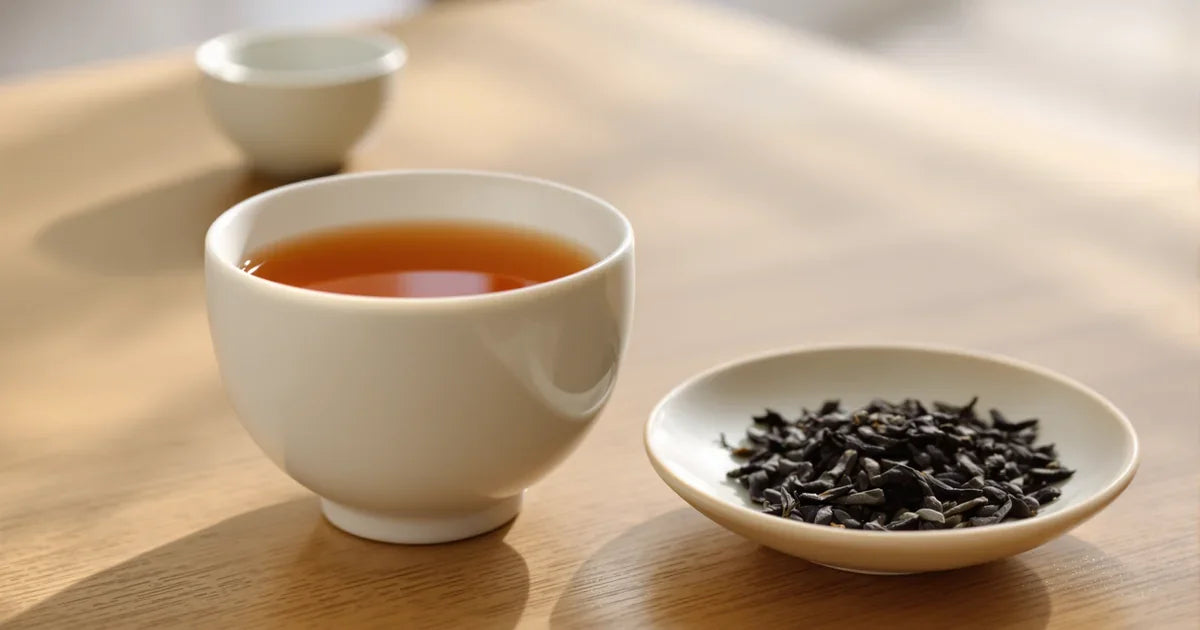

The astringency in green tea comes largely from catechins, a group of polyphenols. When you feel that familiar drying grip at the back of the tongue after a sip of Sencha, that is catechins binding to proteins in your saliva. This interaction helps explain astringency.
The most abundant and most studied catechin is EGCG (epigallocatechin gallate), which makes up roughly 50–70% of total catechins in green tea. EGCG has been studied for antioxidant activity, antimicrobial properties, and cardiovascular markers. What the research shows — and what it does not yet show — is worth understanding alongside the flavor.
The four main catechins in green tea
Catechins are not a single compound. The four main catechins in green tea are related polyphenols with slightly different chemical structures.
| Catechin (abbreviation) | % of total catechins | Key characteristic |
|---|---|---|
| Epigallocatechin gallate (EGCG) | ~50–70% | Most abundant; most studied antioxidant |
| Epigallocatechin (EGC) | Proportion varies | Non-gallate form |
| Epicatechin gallate (ECG) | Proportion varies | Gallate form; contributes to astringency |
| Epicatechin (EC) | Proportion varies | Non-gallate form; less astringent in the cited comparison |
Sources: Khan & Mukhtar (2018) for the EGCG range; Delius et al. (2017) for the saliva-binding comparison.
EGCG dominates — and when people refer to "the antioxidant in green tea," they usually mean EGCG specifically. The gallate esters (EGCG and ECG) are responsible for most of the astringency. Non-gallate forms (EGC and EC) are milder. All four belong to the broader flavonoid family.
One thing all four share: they are unstable under oxidation. During oolong and black tea processing, oxidation changes some catechins into other polyphenols, including theaflavins and thearubigins. Those new compounds create the deep amber color and the different, more mellow astringency of black tea. The amount of catechins remaining depends on the tea and processing conditions. Catechin content varies by tea subtype, source and preparation; a fixed ranking of all tea types is not supported.
What the research suggests about EGCG
EGCG has been studied extensively. The findings are genuinely interesting, though the gap between laboratory results and what a cup of tea actually delivers to the body is real and worth keeping in mind.
Antioxidant activity: EGCG shows strong antioxidant capacity in laboratory conditions — it donates electrons to neutralize free radicals efficiently. Whether drinking tea produces meaningful antioxidant effects in the human body is a separate question, and the evidence is still developing (Higdon & Frei, 2003). For a broader look at how tea antioxidants work and how they compare across tea types, see our guide to green tea antioxidants.
Cardiovascular markers: Randomized trials in adults have examined green tea beverages or extracts and blood lipid levels. A 2011 meta-analysis by Zheng et al. found modest reductions in LDL across multiple studies. These trial findings do not guarantee the same change from an ordinary cup of tea.
Antimicrobial activity: EGCG shows activity against certain bacteria and viruses in laboratory settings. A Japanese trial comparing green tea gargling with water gargling did not find a significant difference in laboratory-confirmed influenza (Ide et al., 2014). Laboratory conditions and the complexity of the human immune system are different environments, so these findings come with appropriate hedging.
Bioavailability: This is the part that complicates the picture. EGCG is poorly absorbed. Chow & Hakim (2011) note that most studies of catechin absorption and oral bioavailability were conducted in laboratory animals; one rat study reported EGCG oral bioavailability of 1.6%. Some studies use concentrated extracts or isolated EGCG; their doses and preparations differ from ordinary brewed tea. This does not make tea worthless, but it does mean direct extrapolation from high-dose laboratory results to everyday tea drinking is not straightforward.
The research suggests catechins are doing something useful. The specific mechanisms and the doses required to see clinical effects in humans are still being clarified. For a broader look at what regular tea consumption is associated with, our guide to green tea benefits covers the epidemiological picture.
How brewing affects catechin extraction and flavor
Catechins are heat-soluble. Within a defined brewing range, higher temperatures can increase catechin extraction; the result also depends on time and the catechin species. Lower temperatures can alter extraction of amino acids and catechins; the ratio depends on the tea and brewing conditions. This is the fundamental flavor tradeoff in brewing green tea.
The practical implications:
- Higher temperatures can increase catechin extraction; astringency also depends on the tea, tea-to-water ratio and time.
- Lower temperatures can change the balance of extracted compounds; sweetness or a higher theanine ratio is not guaranteed by temperature alone.
- Cold brewing can extract catechins, including non-gallate forms; the amount depends on the tea, temperature and steeping time.
- Within a defined brewing range, longer steeping can increase catechin extraction; prolonged heating can also change or degrade catechins.
Catechin content can vary with harvest season, cultivar and growing conditions; later harvests are not guaranteed to contain more.
Brewing temperature is the variable most within your control. Our guide to tea and brewing temperature walks through how temperature affects each tea type. Changes in water temperature during steeping are also part of the brewing conditions; our guide to tea ware materials introduces the vessels themselves.
Tea also contains theanine and caffeine; the composition and form of intake matter when comparing tea with an extract. Our overview of green tea ingredients covers this alongside theanine and caffeine.
Our tea leaf collection includes Sencha from different harvests and growing regions; catechin content depends on the specific tea and preparation.
The health-related information summarized here is based on published research and is provided for educational purposes only. It is not medical advice. If you have specific health concerns, please consult a qualified healthcare professional.
References
- Khan & Mukhtar 2018, Nutrients — review reporting an EGCG share of 50–70% of total catechins.
- Cabrera et al. 2006, Journal of the American College of Nutrition — review article on green tea constituents and related human research.
- Higdon & Frei 2003, Critical Reviews in Food Science and Nutrition — review of tea catechins, polyphenols, metabolism, and antioxidant function research.
- Zheng et al. 2011, American Journal of Clinical Nutrition — meta-analysis of randomized trials on green tea intake and blood lipid measures in adults.
- Manach et al. 2004, American Journal of Clinical Nutrition — review of dietary polyphenol sources and bioavailability.
- Chow & Hakim 2011, Pharmacological Research — review of pharmacokinetic and chemoprevention studies on tea in humans.
- NIH National Center for Complementary and Integrative Health — Green Tea — overview of research, safety and drug interactions.
Frequently Asked Questions
What is the difference between catechins and EGCG?
EGCG is one member of the catechin family — the most abundant and most studied. When someone says "catechins in green tea," EGCG is doing most of the work numerically. EGC, ECG and EC are also among the main catechins in green tea; their proportions vary.
How can Sencha deliver more catechins?
Sencha catechin content depends on the specific tea and preparation. Within a defined brewing range, higher water temperatures and longer steeping can increase catechin extraction; prolonged heating can also change or degrade catechins. Astringency depends on the tea, tea-to-water ratio and time. Our overview of green tea ingredients covers this alongside theanine and caffeine.
How well are catechins absorbed?
EGCG, the most abundant green tea catechin, is poorly absorbed. Most studies of catechin absorption were conducted in laboratory animals. Some studies use concentrated extracts or isolated EGCG; their doses and preparations differ from ordinary brewed tea, so direct extrapolation from high-dose laboratory results to everyday tea drinking is not straightforward. This information is not medical advice. If you have specific health concerns, please consult a qualified healthcare professional.
What causes the astringency in tea?
Catechins are the main contributors to green tea’s astringency. The gallate catechins, EGCG and ECG, account for most of it; they bind to proteins in saliva and create the drying grip we feel after a sip.
How does heat affect catechins during brewing?
Within a defined brewing range, higher temperatures can increase catechin extraction; the result also depends on time and the catechin species. Astringency depends on the tea, tea-to-water ratio and time, and temperature alone does not guarantee sweetness or a higher theanine ratio.