
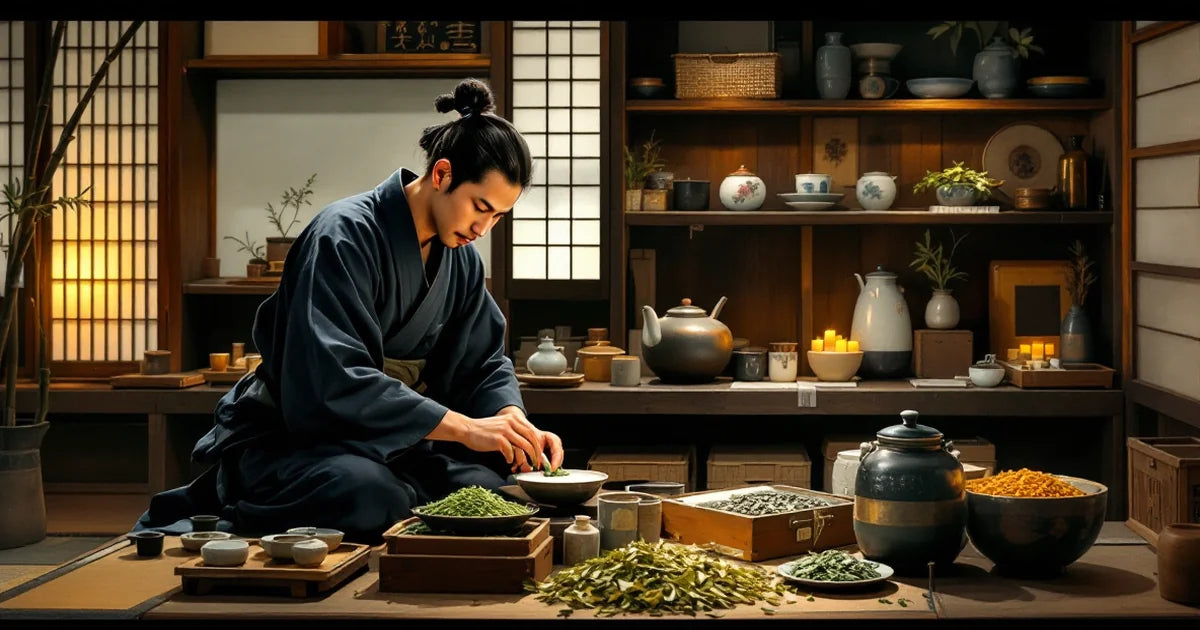
The Edo period (1603–1868) is when tea became Japanese in the fullest sense — no longer a practice of monks and samurai elites, but something ordinary people drank in ordinary homes, bought from shops that lined ordinary streets. The tea ceremony did not disappear, but it was joined by something new: a tea culture of the commons.
Two developments drove this transformation. One was technical: in 1738, a tea farmer named Nagatani Soen developed a new production method that created the green, fragrant, rolled-leaf tea that became modern Sencha. The other was cultural: a dissident monk named Baisao took to the streets of Kyoto selling tea to everyone, and in doing so gave the new Sencha culture its spirit. The previous era's history of the tea ceremony provides useful context for what the Edo period was reacting against.
Sencha and the Popularization of Tea
Before Nagatani Soen's innovation, most common tea was dark, rough, and lacking the bright green color we now associate with Japanese tea. Soen spent years developing the aoseisencha seiho — a method of steaming fresh leaves, then rolling and drying them while shaping them into thin needles. The result: a tea with vivid green color, clean aroma, and layered flavor.
What made Soen's process distinctive was the sequence. Steaming fixed the leaves before oxidation could dull them, and the repeated hand-rolling over heat dried the leaf while giving it a uniform needle shape. Earlier common teas were often cruder in finish or were handled in ways that produced browner liquor and less defined aroma; Soen's method treated the leaf itself as something worth refining.
Soen took his tea to Edo (modern Tokyo), where Yamamoto Kahee of Yamamotoyama — which describes itself as Japan's oldest sencha tea merchant, still operating today — recognized its quality and began selling it. The method spread. By the late Edo period, this style of Sencha had become the dominant Japanese tea.
Gyokuro and the Emergence of Shaded Tea
Gyokuro emerged later in the same period — and its invention is one of the few moments in tea history that can be dated precisely. In 1835, the sixth-generation Yamamoto Kahee developed a shade-grown tea noted in company tradition for its nectar-like sweetness. This was Gyokuro — its name written with characters meaning “jewel dew.” By shading the tea plants for several weeks before harvest, the method suppressed photosynthesis and allowed L-theanine — the amino acid behind umami and sweetness — to accumulate in the leaf. The result was unlike anything in the Japanese tea tradition at that point: deeply savory, with almost no bitterness, and a color so vivid it seemed improbable.
Gyokuro has remained one of Japan's most prized loose-leaf teas ever since. The covered cultivation technique it relies on is the same one used today for the finest Uji and Yame teas. Its invention in the Edo period established a benchmark for premium Japanese green tea that still carries weight today.
That continuity matters. In Uji and Yame today, growers still use the same basic idea of covering the bushes before harvest to slow bitterness and build sweetness, even if the materials and management are more controlled than they were in the nineteenth century. For the highest grades, shading commonly lasts twenty days or more, which is why the best Gyokuro develops such dense umami and such a distinctive deep green leaf.
Baisao and the Senchado Counter-Culture
Baisao — “the old tea seller” — was a Zen monk who retired from temple life and spent his later years taking a portable tea stand through the streets of Kyoto. He sold Sencha to philosophers, poets, merchants, and whoever else wanted a cup, refusing to charge fixed prices and insisting that tea required no ceremony, no hierarchy, no special room. His act was explicitly political. The formalized tea ceremony of the time was associated with status and power — Baisao wanted to strip all of that away and return tea to something honest and direct.
The movement he inspired, Senchado — the way of Sencha — developed as a philosophical counter-culture to the chado establishment. Where chado emphasized discipline, correct form, and the mastery of ritual, Senchado emphasized informality, intellectual conversation, and the naturalness of a simple cup. Chinese literati culture was a significant influence: Senchado incorporated Chinese aesthetics, Chinese tea wares, and the Chinese ideal of tea as accompaniment to scholarship rather than ceremony.
Late in life, Baisao is said to have burned his tea utensils — a gesture against the commodification of everything, including his own practice. The movement he started continued without him, shaping the philosophical dimension of Japanese tea culture in ways that the ceremony alone never could.
Tea Shops and the Merchant Class
The Edo period built the commercial infrastructure that made tea accessible. Wholesalers, brokers, and retailers organized distribution networks across the country. Tea shops became a feature of urban life — places where quality was assessed, relationships were maintained, and tea culture was transmitted to a non-aristocratic public.
These shops did not sell only one kind of tea. Customers could buy everyday Bancha for household use, better Sencha for regular drinking, and finer regional teas from places such as Uji for gifts or status-conscious occasions. Because merchants had to sort lots, judge leaf appearance and aroma, and price tea in ways customers trusted, the shop system also helped create practical quality standards that producers then had to meet.
Japan's overseas tea trade was tightly restricted throughout the Edo period. The first recorded export was by the Dutch East India Company from Hirado in 1610, and trade remained limited to designated ports under the sakoku restrictions. Exports expanded sharply after the ports opened in 1859, foreshadowing the massive expansion of the Meiji era.
Legacy of the Edo Period
The Edo period's most lasting contribution was normalizing tea. The ceremony remained an art form and a discipline. But the ordinary act of boiling water, brewing leaves, and drinking tea in the morning or after a meal — this became a Japanese habit in the Edo period, and it has not substantially changed since. The Sencha that Nagatani Soen developed is still the template for the tea most Japanese people drink today. The Gyokuro that the sixth Yamamoto Kahee developed in 1835 remains one of the benchmarks for premium Japanese green tea. And the spirit of Baisao — tea as something immediate, honest, and available to everyone — is still present in how the best Japanese tea shops think about what they do.
Just as important, the Edo period made tea into an everyday purchase: not a rare luxury reserved for temples, elites, or formal gatherings, but something households expected to buy again when the jar started to run low.