
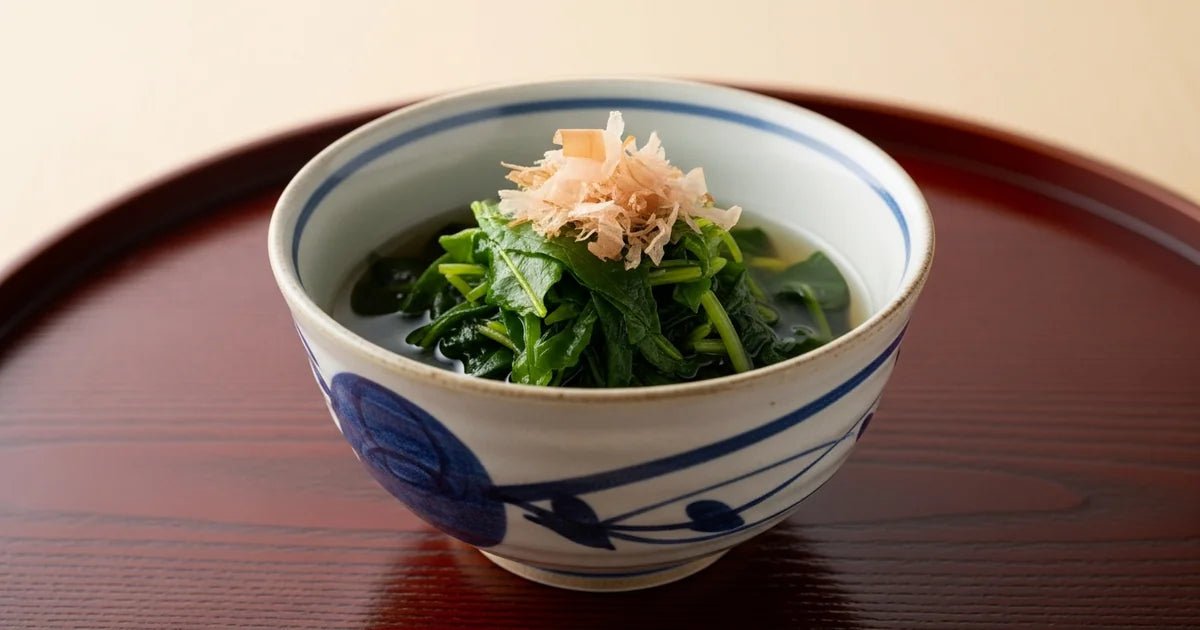
The leaves at the bottom of the kyusu still smell green, soft, slightly savory. Yes, you can eat tea leaves. If you are asking can you eat tea leaves, or are tea leaves edible, the answer is yes: tea leaves made for drinking are food, and in Japan they are often eaten after brewing. One of the simplest ways is ohitashi — a blanched green side dish dressed with a little soy sauce. It is quiet food. Nothing ornate. Just a small dish that lets the leaf finish its work.
That idea makes sense once you look at the leaf itself. Brewing moves part of the caffeine and catechins into the cup, but the used leaves still hold fiber, chlorophyll, minerals, and other nutrients. They also lose some of their sharpness after the first infusion, which is why eating tea leaves often feels gentler than chewing fresh raw leaves. For a broader look at what remains in the plant, see our notes on green tea nutrients and catechins.
Can you eat tea leaves?
Yes. Tea leaves are edible. In fact, every bowl of Matcha is already whole-leaf tea in powdered form, so the idea is not unusual at all. What changes is texture. Loose leaves are fibrous, and fresh tea leaves can be quite astringent, especially if they have not been softened by heat or brewing. Used leaves, by contrast, are tenderer and milder.
The first infusion carries away much of the bitterness-building caffeine and catechins, leaving behind a leaf that is easier to season and easier to enjoy. That does not mean the leaf is empty. It still contains insoluble parts of the plant, including fiber and chlorophyll, along with vitamins and minerals that do not all vanish into water. If you want the fuller nutritional picture, this is one reason eating tea leaves can be interesting alongside drinking them.
One practical note. Eat leaves that were meant to be brewed as tea, not decorative garden leaves or anything that may have been sprayed. Fresh tea leaves can certainly be cooked, but for most people the safest and easiest starting point is the used leaf from a pot of green tea you have just brewed. It has already been rinsed by hot water and softened by the infusion.
There is also a cultural side to this. Tea in Japan has long lived close to the kitchen. Not just in cups, but in rice, sweets, condiments, and simple home cooking. When the tea is good and the leaves are soft, throwing them away immediately can feel premature. A small dish of ohitashi answers that instinct neatly. It uses almost no extra ingredients, and it respects the leaf instead of masking it.
For this kind of cooking, used Sencha is the easiest place to start. Deep-steamed tea, often called Fukamushi, also works well because the leaves soften quickly. Fresh tea leaves can be eaten too, but they usually need more handling and their raw edge is stronger. If your question is simply “eating tea leaves: safe or not?” the everyday answer is this: brewed tea leaves from drinkable green tea are food, and they make especially good sense in small, seasoned dishes.
Find the right tea leaves for your next ohitashi
Ohitashi — a Japanese recipe for used tea leaves
Ohitashi means blanched greens dressed simply, most often with soy sauce. Spinach and komatsuna are the classics. Used green tea leaves slip into the same logic beautifully. The flavor is grassy, faintly marine, a little nutty if the tea was deep-steamed. Not a salad, exactly. More like a quiet side dish you serve beside rice, tofu, or grilled fish.
The best leaves for this recipe are used Sencha or Fukamushi leaves from the first or second infusion. They should still smell fresh and clean. If the brew was made very strong and the leaves taste too sharp, a 10 to 15 second blanch smooths them out.

What you need
- Used green tea leaves from Sencha or Fukamushi, enough for a small side dish
- A small pot of boiling water
- A few drops of soy sauce
- A pinch of bonito flakes (katsuobushi)
- Optional: toasted sesame seeds, a drop of sesame oil, or a little grated ginger
That is all. No elaborate seasoning, because the point is to let the leaf stay recognizable. The used leaves already carry the memory of the tea you just brewed.
Step 1: Collect the leaves
Scoop the brewed leaves out of the kyusu or teapot while they are still moist. If there is a lot of liquid clinging to them, let them rest for a moment in a sieve or on a paper towel. You do not need to dry them completely. Just remove the extra water so the seasoning will not turn watery.
This is also the moment to taste a pinch. If the leaf is already mild, you can skip blanching and go straight to seasoning. If it feels too bitter, move to the next step.

Step 2: Blanch very briefly
Bring water to a boil and dip the used leaves in for 10 to 15 seconds. No more. This is not meant to cook them heavily; it is only enough to round off any remaining harshness. Fresh tea leaves would need more care, but used brewed leaves soften fast.
Drain them immediately. Then squeeze gently with your hands or press lightly in a cloth or paper towel. You want the leaves damp and tender, not dripping. Too much water will thin the soy sauce and flatten the dish.

Step 3: Dress and serve
Place the leaves on a small plate. Add a few drops of soy sauce, just enough to wake the leaf up. Scatter bonito flakes on top. Their savory depth gives the dish a little lift and turns the tea’s green flavor into something rounder and more complete.
If you want variation, add toasted sesame seeds, a drop of sesame oil, or a touch of grated ginger. Keep the seasoning light. Ohitashi is best when it tastes like the leaf first and the dressing second.

A small bowl of rice beside it helps. The soy sauce catches the steam, the bonito softens, and the leaf’s faint bitterness becomes appetizing rather than aggressive. This is the kind of dish that makes sense at the edge of a meal, not at the center. A condiment-sized portion. A few bites. Enough to notice the tea from another angle.
Served this way, the tea leaves become something between a relish and a green side dish. Soft, savory, slightly bittersweet. If you are brewing good Sencha anyway, the distance between cup and plate is very short. And if you want to start earlier in the process, our guide to brewing Sencha and deep-steamed tea helps you get leaves that are pleasant to eat after the cup is finished.
Other ways to eat tea leaves
Ohitashi is the simplest way to eat used tea leaves, but it is far from the only one. Once you treat brewed leaves as an ingredient rather than waste, the options open up quickly — fried rice, tempura, furikake, and more. Each method works because the leaf's bitterness and aroma are mild enough to pair well with everyday foods.
Mix used tea leaves into fried rice for a gentle green bitterness. Fold them into pasta with butter, soy sauce, and mushrooms. Add tender fresh leaves to salad if the leaves are young and untreated. Blend a small amount into a smoothie. In Japan, fresh leaves are sometimes battered and fried as tempura too, where the crisp coating softens their astringency and lets the aroma rise.
You can also dry used leaves a little and turn them into a rough furikake-style topping with sesame and salt, or stir them into soft scrambled eggs where their bitterness stays very quiet. Some uses are better for fresh leaves. Some are better for used ones. Fresh leaves keep more bite and more bitterness. Used leaves are softer, quieter, and often easier to pair with everyday foods. That is why ohitashi, furikake, or fried rice tend to work so well: they accept the leaf as it is, without asking it to become something else.
If you want a longer list, we gathered more ideas in our article on more uses for used tea leaves. The larger point is simple. Tea is not always finished when the liquor is gone. Sometimes the second life of the leaf is small, practical, and delicious.
In Japan, nothing is wasted if it still has flavor to give. Used tea leaves are food, not garbage. Brew them, enjoy the cup, then dress the leaves and place them on a small plate. One plant. Two pleasures.