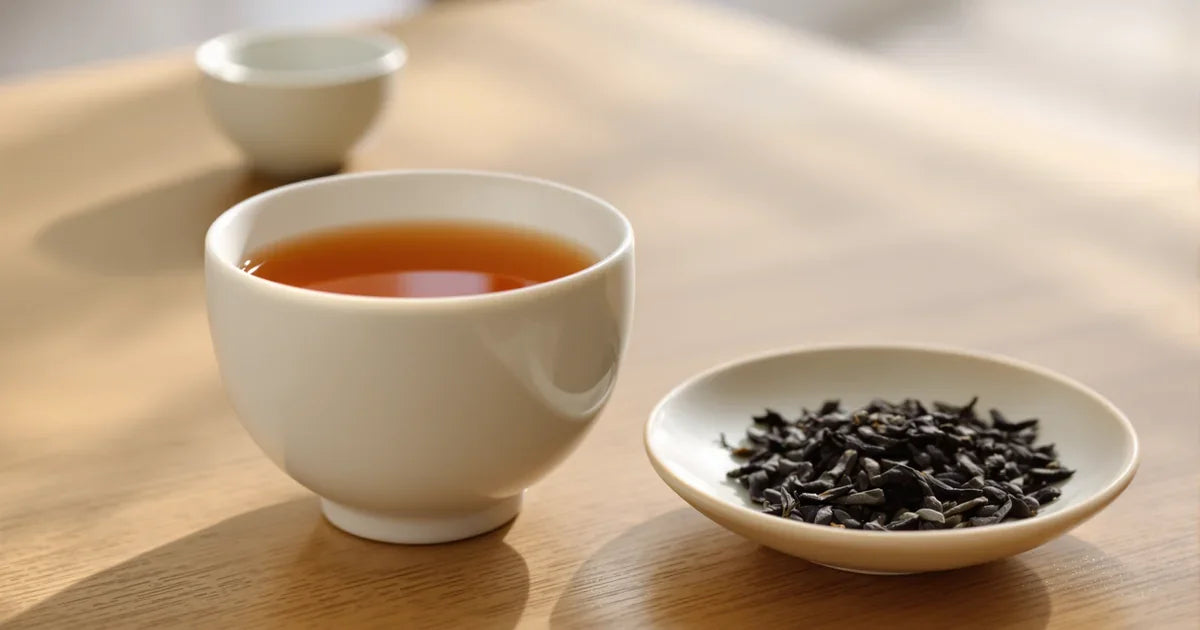

Steamed greens, sweet pea, a faint edge of bitterness. Yes, green tea has caffeine. If you are asking, does green tea have caffeine, the practical answer is yes: most everyday cups land around 30 to 50mg. But the range is much wider than many people expect. Under MEXT's specified infusion conditions, Gyokuro contains 160mg of caffeine per 100g of infusion and Bancha 10mg per 100g, a concentration ratio of 16 to 1. The brewing conditions differ, so this is not a comparison of typical cups.
That gap is part of what makes green tea so interesting. The phrase "green tea" covers shaded teas, unshaded teas, powdered teas, roasted teas, rice-blended teas, spring harvests, late harvests. Different leaves. Different brewing ratios. Different cups. If we only ask whether green tea has caffeine, we miss the better question: how much, and why does it change so dramatically from one tea to the next?
Once we look at the numbers from Japan's Standard Tables of Food Composition (8th edition, 2020), the mystery clears. The concentration in the leaf matters. The size of the cup matters. The way the tea was grown matters.
And if you want a broader map beyond green tea alone, our guide to tea ingredients and caffeine helps place these cups in context.
The caffeine in common green teas
Green tea is not one fixed caffeine drink. In Japan's food composition tables, brewed Gyokuro contains 160mg of caffeine per 100ml, Sencha and Hojicha 20mg, and Genmaicha 10mg, while a 2g serving of Matcha provides about 64mg. Then cup size pushes the total higher or lower.
The clearest starting point is the Japanese Standard Tables of Food Composition. These are concentration numbers, measured under standard conditions. They tell us how strong the tea liquor is, not how much you personally drank. That distinction matters because a 50ml Gyokuro pour and a 200ml mug of Genmaicha create very different caffeine totals, even before we talk about leaf quality.
- Gyokuro: 160mg per 100ml of brewed tea
- Sencha: 20mg per 100ml of brewed tea
- Hojicha: 20mg per 100ml of brewed tea
- Genmaicha: 10mg per 100ml of brewed tea
- Matcha: about 64mg per 2g serving
Per 100ml is not the same as per cup
A typical cup of green tea is often 150 to 200ml. So a standard 150ml cup of Sencha works out to about 30mg of caffeine, and a 200ml cup can reach about 40mg. Genmaicha at 10mg per 100ml lands closer to 15 to 20mg in that same cup range. Those are gentle numbers for most people, especially if the tea is sipped slowly with food.
Gyokuro is the outlier. At 160mg per 100ml, even a small 50ml serving carries about 80mg. At 100ml, you are already at 160mg. That is why Gyokuro often feels so dense and vivid. The serving vessel may be small, but the liquor is concentrated. A light Bancha, by contrast, can sit far lower, which is how one cup of green tea may contain several times less caffeine than another.
Matcha changes the math
Matcha deserves its own category because we are not just drinking an infusion. We are consuming the powdered leaf itself. A modest 2g serving contains about 64mg of caffeine, already above many everyday cups of Sencha. If we make a larger bowl with more powder, the number rises with it. Matcha is still green tea, but in caffeine terms it behaves closer to a compact, concentrated serving than a casual pot tea.
One more nuance. Hojicha often has a lower-caffeine reputation because it tastes mellow and roasty, but the standard table places brewed Hojicha at 20mg per 100ml, similar to Sencha under the same conditions. We go deeper into that point in our notes on Hojicha caffeine. Roast changes flavor dramatically. Caffeine, not always as much as people assume.
Why does one green tea wake you more than another?
The biggest caffeine gaps in green tea come from three things: shade, season, and brewing ratio. Covered teas such as Gyokuro build more caffeine before harvest, first flush leaves tend to be richer than later pickings, and a heavy dose of leaf changes the cup faster than a small drop in water temperature.
Shade deepens the leaf
Some of Japan's most caffeine-rich green teas are grown under cover before harvest. This practice appears as kabuse or ooishita cultivation, meaning the tea plants are shaded with cloth or other material to reduce sunlight. Covered cultivation encourages the leaf to hold onto more caffeine and amino acids, which is part of why Gyokuro tastes thick, sweet, and intensely savory. We wrote more about that growing method in our article on covered cultivation of tea.
Shade does not act alone, but it sets the tone. A sun-grown everyday Sencha can be brisk and refreshing at around 20mg per 100ml. A shaded Gyokuro from tender spring growth can jump to 160mg per 100ml. Same plant species. Same broad category of green tea. Very different field conditions.
Early harvests tend to be stronger
The first flush, picked in spring, usually gives the most prized leaves. They are young, soft, and full of stored compounds built up during winter dormancy. Those spring leaves often carry more caffeine than later summer or autumn harvests. Bancha, which is usually made from later, coarser leaves, tends to drink more lightly. Less sharpness. Less intensity. Often less caffeine too.
This is one reason a premium tea can feel so different from an everyday house tea, even when both are green. Price is not just ceremony or branding. Sometimes it reflects harvest timing and labor, and those choices affect the chemistry in the cup.
Leaf quantity matters more than kettle temperature
People often focus on water temperature. Cooler water, less caffeine. Hotter water, more caffeine. There is some truth there, but the bigger lever is usually how much leaf we pack into the brew. A concentrated Gyokuro recipe might use 5 to 6g of leaf for 50 to 100ml of water. A casual mug infusion might use 3g for 200ml. Even if the water is cooler, that first brew can still deliver a great deal of caffeine because the leaf-to-water ratio is so high.
Brewing time matters as well. Later infusions are not reliably lighter, though: depending on the tea and steeping time, a second infusion can carry more caffeine than the first. So when we talk about green tea caffeine, we are really talking about agriculture and preparation together. The field starts the story. The teapot finishes it.
Green tea and coffee, cup to cup
Coffee usually has more caffeine per serving than green tea: about 95mg in an 8oz cup versus roughly 30mg in a cup of Sencha. Yet the feeling is not identical. Green tea also brings theanine, which can soften the edge of stimulation and create a calmer, steadier alertness.
The raw numbers
According to the Mayo Clinic's caffeine guide, a typical 8oz cup of brewed coffee contains about 95mg of caffeine. Compare that with a 150ml cup of Sencha at around 30mg, a 200ml cup around 40mg, or a 2g serving of Matcha at about 64mg. In most everyday comparisons, coffee is still the higher-caffeine drink.
That said, green tea is not always low. A small serving of Gyokuro can already approach coffee territory, and Matcha can narrow the gap quickly if we use more powder. Two bowls of Matcha in a morning may easily put someone in the same general range as a mug of drip coffee. Dose matters. So does format.
Why the experience can feel calmer
Many tea drinkers say coffee gives them a quick lift while green tea feels steadier. Part of that difference comes from how we drink it. Tea is often sipped more slowly. Cups are smaller. But chemistry also plays a role. Green tea contains theanine, an amino acid associated with a more relaxed, attentive state. We explain that relationship in more detail in our piece on tea ingredients and theanine.
The effect is not that theanine cancels caffeine. It does not. If a tea is high in caffeine, you may still feel it clearly.
But theanine can change the texture of the experience. Less spike, less brittle edge, more of a long, level concentration. That is the difference many people describe as calm alertness rather than jittery energy.
At the same time, it helps to be honest about sensitivity. If 95mg of coffee makes you jittery, a strong bowl of Matcha or a concentrated Gyokuro may also be too much on an empty stomach. Green tea can be gentler than coffee, but it is not automatically mild. The numbers still matter.
How to lower the caffeine in your cup
If you want less caffeine, the easiest move is choosing a gentler tea before you change your kettle. Genmaicha, Bancha, and stem tea often land lower than Gyokuro or Matcha; later steeps are not reliably lower. In NARO's measurements, Sencha steeped in refrigerator-cold water (about 10°C) released about half the caffeine of a 2-minute brew at 80°C, and the level did not rise with 16 to 24 hours of steeping. Cold brew is not caffeine-free, and the amount in the cup depends on how much leaf you use.
Choose a lighter style of tea
If your goal is an easy afternoon or evening cup, start with the tea itself. Genmaicha, with its blend of green tea and roasted rice, is often one of the softest choices. Bancha, made from more mature leaves, usually drinks less intensely than spring Sencha. Stem tea, called Kukicha, can also be a good option because the stems often contain less caffeine than tender leaf material.
Hojicha can be another comfortable choice, especially if the stem content is high, though as noted above its standard concentration is about the same as Sencha. Flavor can trick us. Toasted, nutty, soft. When looking specifically to reduce caffeine, Genmaicha, Bancha, or Kukicha remain the more reliable choices.
Change the extraction
If you already have a tea you love, brewing can help. Cold water extracts caffeine more slowly than hot water, which is one reason cold brew green tea often tastes sweet, rounded, and comparatively gentle. Our guide to cold and ice brew tea walks through the method in more detail.
Later steeps are not a reliable shortcut: in Japanese studies of Sencha, the second infusion sometimes released more caffeine than the first, depending on how the tea was steeped. In a Japanese laboratory study, the caffeine extracted rose in proportion to the amount of leaf when 3 to 12g of Sencha was brewed in the same 260ml of water, so using less leaf for the same amount of water is a direct way to brew a cup with less caffeine.
Match the tea to the hour
We often think of caffeine as a yes-or-no question, but in practice it is about timing. A 30mg Sencha with breakfast may feel perfect. A 64mg Matcha at 9pm may not. Once we know the rough range, we can choose more deliberately: shaded teas for focused mornings, everyday Sencha for midday, and softer teas for late afternoon. NARO recommends cold-brewed Sencha for people concerned about caffeine: in its measurements in refrigerator-cold water (about 10°C), extraction was about half that of a 2-minute brew at 80°C, not zero; the cup's amount depends on how much leaf you use.
That kind of choice is more useful than chasing a single rule. Not all green tea is high in caffeine. Not all green tea is low. The better question is which green tea, how much leaf, how much water, and what kind of day you are having.
A note on caffeine during pregnancy
If you are pregnant or thinking about becoming pregnant, the numbers matter more than usual. The FDA's general guidance suggests up to 400mg of caffeine per day for healthy adults, but the American College of Obstetricians and Gynecologists (ACOG) recommends limiting caffeine to 200mg per day during pregnancy. Research suggests that higher intake may be associated with increased risk, though the evidence is still evolving. A 150ml cup of Sencha at roughly 30mg sits comfortably within that range; a concentrated Gyokuro or a large Matcha serving may not. Please consult your healthcare provider about what is appropriate for your situation — individual health circumstances vary, and this article is not a substitute for personalised medical advice.
At FETC, we think caffeine numbers do not take the poetry out of tea. They give us freedom. A small cup of Gyokuro when we want depth and focus. Sencha when we want everyday clarity. Genmaicha, Bancha, or Kukicha when we want something softer. Knowing the range lets us choose the right tea for the moment, not just the right tea in theory.
So yes, green tea has caffeine. Sometimes 10mg in a gentle cup. Sometimes 30 to 50mg in an everyday serving. Sometimes much more. Once we understand that spread, green tea becomes easier to live with and easier to love.
This article is general information, not medical advice. If you have specific concerns about caffeine and your health, consult a qualified healthcare professional.
References
- MEXT — Food Composition Database — government food-composition dataset for caffeine values across tea types.
- FDA — Caffeine consumer guidance — federal consumer guidance on daily caffeine intake.
- NIH Office of Dietary Supplements — Caffeine — professional reference on caffeine metabolism and intake ranges.
- Chen et al. (2022), International Journal of Molecular Sciences — shading study on tea plants grown for matcha: compared with open-air plants, leaves grown under 85% and 95% shade had more theanine and caffeine and less epicatechin and epigallocatechin.
- Mayo Clinic — Caffeine in drinks — clinical reference for comparing caffeine in coffee, tea, and other beverages.
- ACOG — Moderate caffeine during pregnancy — professional medical society guidance on caffeine during pregnancy.
- Tea Association of the U.S.A. — industry association source for North American tea data.
For a complete picture of green tea — what it is, how it differs from other teas, and what the oxidation level means for flavor — see our guide to green tea. For a deeper look at Matcha caffeine specifically, see does Matcha have caffeine.
Frequently Asked Questions
How much caffeine is in a typical cup of green tea?
Most everyday cups land around 30 to 50mg. A 150ml Sencha is about 30mg, while Genmaicha is closer to 15 to 20mg in a similar cup.
Why does Gyokuro have so much more caffeine than Sencha?
Gyokuro is usually shaded before harvest, made from tender spring growth, and brewed with a high leaf-to-water ratio. That combination can reach 160mg per 100ml.
Is Matcha higher in caffeine than brewed green tea?
Often, yes. With Matcha we drink the powdered leaf itself, so a modest 2g serving gives about 64mg, higher than many everyday cups of Sencha.
Does Hojicha always have less caffeine because it is roasted?
Not always. Hojicha tastes mellow and roasty, but the Japanese tables list brewed Hojicha at 20mg per 100ml, similar to Sencha under standard conditions.
How can we make a lower-caffeine green tea cup?
Start with a gentler tea such as Genmaicha, Bancha, or Kukicha, then use less leaf; later steeps are not reliably lower in caffeine. NARO recommends cold-brewed Sencha for people concerned about caffeine: in its measurements in refrigerator-cold water (about 10°C), extraction was about half that of a 2-minute brew at 80°C, not zero; the cup's amount depends on how much leaf you use.
Does green tea have less caffeine than coffee?
Usually, yes. According to the Mayo Clinic's caffeine guide, a typical 8oz cup of brewed coffee contains about 95mg of caffeine, compared with a 150ml cup of Sencha at around 30mg. Green tea is not always low, though: a small serving of Gyokuro can already approach coffee territory, and Matcha can narrow the gap quickly if we use more powder.
How much green tea is safe during pregnancy?
The American College of Obstetricians and Gynecologists (ACOG) recommends limiting caffeine to 200mg per day during pregnancy. A 150ml cup of Sencha at roughly 30mg fits comfortably within that range; a concentrated Gyokuro or a large Matcha serving may not. Please consult your healthcare provider about what is appropriate for your individual situation, as this article is not a substitute for personalised medical advice.