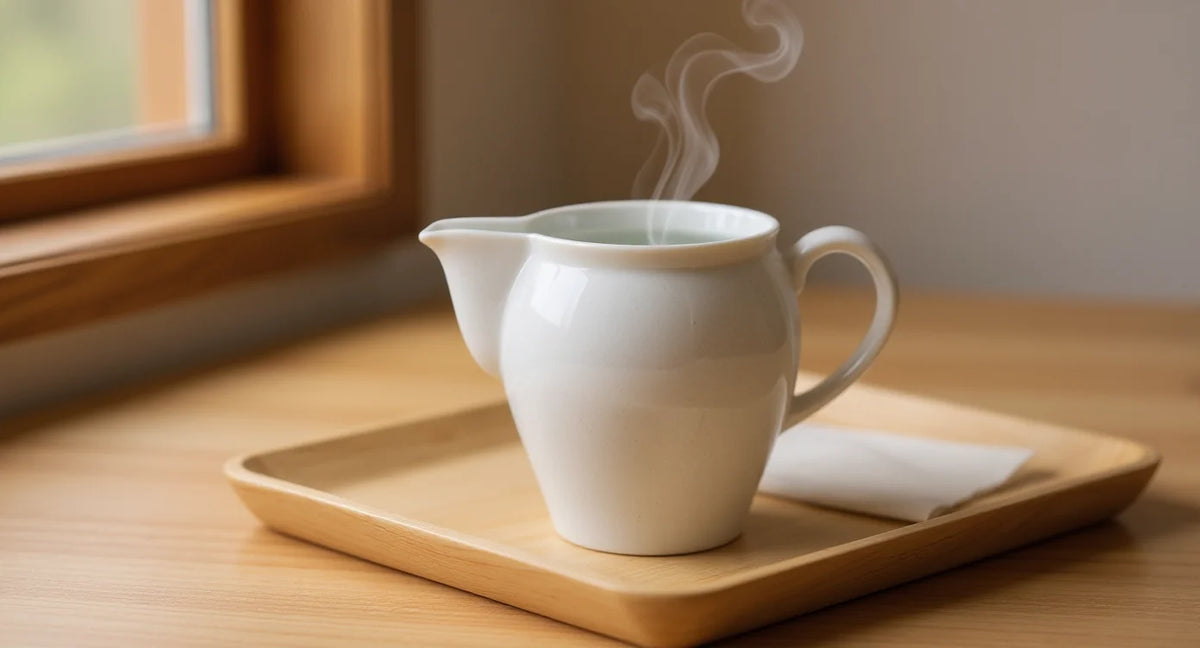

There is a moment, right before the leaves catch, when the kitchen fills with something you cannot quite name — toasted grain, a wisp of caramel, the faintest edge of smoke. That is the scent of Hojicha being born.
Hojicha is made by roasting finished green tea — usually Bancha or stem tea — at a roasting-drum wall temperature of about 160–180°C, the range that a 1969 roasting trial by Japan's Ministry of Agriculture and Forestry Tea Experiment Station suggested was suitable for roasting. The heat triggers a cascade of chemical changes: pyrazines form (the source of that roasted aroma), amino acids react with sugars to produce melanoidin (one of the heat-driven changes that contributes to the brown colour of the leaves and liquor), and a portion of the caffeine volatilizes away.
What roasting does to a tea leaf
Green tea leaves are already fully processed — steamed, rolled, dried — before roasting begins. What the roaster adds is transformation through heat. Understanding these changes helps explain why Hojicha tastes so different from the green tea it started as.
The most important change is the creation of pyrazines, a family of aromatic compounds responsible for Hojicha's signature warmth. Pyrazines form when amino acids and sugars undergo the Maillard reaction at high temperatures. The same chemistry gives roasted coffee and toasted bread their familiar scent.
Meanwhile, catechins — the compounds behind green tea's sharp astringency — partially break down. The result is a cup that feels gentler on the palate, with rounded sweetness in place of the bite you might expect from a Sencha or Gyokuro.
Caffeine, too, is affected. A fraction sublimes off during roasting — though the final caffeine level depends on the base tea and how it is brewed. Note that the chemical profile of Hojicha — vitamins, minerals, specific antioxidants — is covered in detail in our Hojicha ingredients guide; this article focuses on the roasting process itself.
The roasting process step by step
Choosing the raw material
Not every green tea becomes Hojicha. The classic base is Bancha — the larger, mature leaves harvested later in the season. Stem tea (*Kukicha*) is another common choice; roasted stems produce a lighter, sweeter cup sometimes called *kuki-Hojicha*. Some producers use late-harvest *ichibancha* (first-picked tea) for a more refined Hojicha with deeper sweetness.
Traditional method: the horoku
Before industrial roasters existed, tea was roasted in a *horoku* — a flat, unglazed ceramic pot held over charcoal. The potter's clay distributed heat gently and absorbed moisture from the leaves. Artisan producers in Kyoto and Shizuoka still use this method for small batches, prizing the softer, more layered aroma it produces.
Modern method: the rotating drum
Commercial Hojicha is roasted in a rotating metal drum, similar in concept to a coffee roaster. The drum tumbles the leaves continuously, ensuring even heat distribution and consistent color. Temperature and time can be precisely controlled, making it possible to produce large volumes of Hojicha with reliable quality. Most of the Hojicha you find in stores and tea shops is made this way.
Process overview
| Step | What happens | Temperature | Time |
|---|---|---|---|
| Preheating | Roasting drum preheated | Drum inner wall: about 160–180°C (1969 trial) | — |
| Loading | Dried green tea leaves added in a thin, even layer | — | — |
| Initial roasting | Moisture evaporates; leaves begin to change color | — | 1–3 min |
| Main roasting | Maillard reaction peaks; pyrazines form; aroma intensifies | — | 2–5 min |
| Cooling | Leaves spread on a flat surface or cooling tray to stop the reaction | Room temp | Immediate |
The total active roasting time is usually under ten minutes. The cooling step matters more than it might seem — without rapid cooling, residual heat continues the reaction and can push the leaves past the intended roast level.
Light roast versus dark roast
Not all Hojicha is roasted to the same depth. Lighter roasts retain more of the original green tea character — a subtler aroma and a pale amber liquor. Darker roasts develop deeper, chocolatey notes with a richer, more intense colour. Neither is better; the choice comes down to the base tea and how the producer wants the finished cup to taste.
How to roast Hojicha at home
You do not need a *horoku* or a drum roaster. A frying pan and a few minutes of attention will do. We recommend starting with an inexpensive Bancha or Hojicha you already have — the technique is forgiving, and the smell alone is worth the experiment.
- Spread a thin layer of tea leaves in a dry, unheated frying pan. Turn the heat to medium. Do not add oil.
- Let the leaves sit undisturbed for about a minute. Resist the urge to stir — you want the bottom layer to begin releasing moisture before you move anything.
- Once you catch the first wave of aroma, begin stirring gently with a wooden spatula. Keep the leaves moving to avoid scorching. Roast until they reach the color and fragrance you like — usually two to four minutes total.
- Remove from heat immediately and spread the leaves on a plate to cool. Brew with water just off the boil and steep for about 30 seconds. The liquor should be a clear reddish brown. If the color seems a little deep, that is exactly right.
For more on Hojicha's nutritional profile after roasting, including how the process affects vitamins, minerals, and antioxidants, see our detailed breakdown. The broader story of Hojicha's origins, styles, and character is in our Hojicha hub article. And if you want to compare Hojicha directly with Bancha, the Bancha vs. Hojicha guide covers that ground.
Explore our Hojicha and other roasted teas.
Frequently Asked Questions
What makes Hojicha smell roasted instead of grassy?
Roasting finished green tea triggers Maillard reactions between amino acids and sugars. That creates pyrazines, the compounds behind Hojicha’s toasted grain, caramel, and faint smoky aromas.
Which teas are usually used to make Hojicha?
Bancha is the classic base because its larger mature leaves roast well. Stem tea makes a lighter, sweeter kuki-Hojicha, while late-harvest ichibancha can give a more refined cup with deeper sweetness.
How do light and dark roasts change the flavor?
A light roast keeps more green tea character, with a subtler aroma and pale amber liquor. A darker roast brings deeper color and chocolatey notes.
Why does cooling matter after roasting?
Active roasting usually takes under ten minutes, but the leaves keep reacting if they stay hot. Spreading them on a tray or plate stops residual heat from pushing the roast past the intended level.
Can we roast Hojicha at home without special equipment?
Yes. Use a dry frying pan, no oil, medium heat, and a thin layer of tea. Let it sit about one minute, stir gently after the aroma rises, roast two to four minutes, then cool immediately.