
Arita and Imari Porcelain: Japan's First Export Ceramics
When European collectors in the seventeenth century spoke of the finest porcelain in the world, they meant Arita. Long before Meissen or Sèvres, Japan's Arita region was producing white porcelain of a quality that European kilns could not match. Dutch merchants loaded ship after ship with these pieces — through the port of Imari — and carried them to the courts of Europe, where they were displayed alongside paintings and sculpture as objects of the highest prestige. The English still call this tradition Imari. The Japanese call it Arita. Both names are correct, and the distinction between them is more interesting than it first appears.
Arita vs Imari: same clay, different names
The pottery is made in and around Arita Town in Saga Prefecture. Arita sits inland, surrounded by mountain ridges that contain deposits of the feldspathic clay used to make Japanese porcelain. Imari is a port town about fifteen kilometres away on the coast. In the Edo period, Arita ware was transported to Imari and loaded onto Dutch East India Company ships. Because Imari was where European traders encountered the ware, the name "Imari" became the European designation for this entire style of Japanese porcelain.
Within Japan, Arita ware (有田焼) is the production-centred name, and the styles made for export — particularly the bold, layered designs with red, gold, and deep blue — are called ko-Imari (古伊万里, Old Imari). Modern pieces made in Arita are generally called Arita ware; the term "Imari ware" tends to suggest the historical export styles or collector-grade antique pieces.
| Arita ware 有田焼 | Old Imari 古伊万里 | |
|---|---|---|
| Origin | Arita Town, Saga Prefecture | Same — Arita production, Imari port export |
| Style | Broad range — from minimalist to elaborate | Bold, layered red/gold/blue export aesthetic |
| Known for | Kakiemon, Nabeshima, modern Arita styles | The export aesthetic (influenced Meissen, Delft) |
| Tea pairing | Sencha, Gyokuro | Formal settings, ceremony |
Japan's first porcelain: how Arita got started
The history of Arita porcelain begins in 1616, when Korean potter Yi Sam-pyeong (Ri Sampei in Japanese) is credited with discovering kaolin clay at Izumiyama, a mountain near Arita. Yi Sam-pyeong had been brought to Japan during Toyotomi Hideyoshi's invasions of Korea (1592–1598), along with many other skilled Korean potters. The discovery of suitable clay transformed Kyushu's ceramics industry — for the first time, Japan could produce white porcelain of the quality previously available only from China.
Production expanded rapidly. By the mid-seventeenth century, Arita's kilns were producing export-quality porcelain in significant quantities. The Dutch East India Company (VOC), which had exclusive trading rights in Japan, recognised the commercial opportunity and began purchasing Arita ware for European markets. When Chinese porcelain exports declined during the political instability of the late Ming and early Qing dynasties, the VOC turned increasingly to Arita to fill the gap. Between the 1650s and 1740s, tens of thousands of pieces — perhaps hundreds of thousands — left Imari port for Europe.
The impact on European ceramics was profound. Meissen's early decorated porcelain was directly inspired by Arita styles. Delft blue and white pottery imitated the Japanese cobalt painting tradition before European kilns could produce true porcelain. The aesthetic of Arita — whether in the Old Imari layered style or the more restrained Kakiemon — influenced European decorative arts for generations.
The major styles: Kakiemon, Nabeshima, and Old Imari
Arita porcelain is not one thing. Over four centuries of production, several distinct styles developed, each with its own aesthetic logic.
Kakiemon (Kakiemon-de, 柿右衛門様式) is perhaps the most internationally recognised. The Kakiemon style uses a distinctive milky white ground — nigoshide (濁手) — with sparse, asymmetric decoration in soft red, blue, green, and yellow. The designs often feature birds, flowers, and figures from nature, painted with deliberate openness: a single branch, a butterfly, empty space around it. European collectors prized Kakiemon extravagantly; Augustus the Strong of Saxony reportedly traded 600 soldiers for a set of Kakiemon vases.
Nabeshima (Nabeshima-de) was the feudal lord's ware — produced exclusively for the Nabeshima clan and the shogunate, not for sale. The quality control was rigorous: pieces that failed to meet the standard were destroyed. Nabeshima designs combine underglaze blue painting with overglaze colours, following strict compositional rules. The foot ring is typically higher than other styles and painted with a comb pattern. Authentic historical Nabeshima pieces are among the most valuable Japanese ceramics.
Old Imari (Ko-Imari) is the layered, colourful style made for European export. Deep cobalt blue underglaze, overglaze red and gold, dense pictorial compositions filling most of the surface. This was the style that most influenced Meissen and European interpretations of "Japanese" porcelain. It is more decorative and more visually aggressive than Kakiemon — colour used to impress rather than to suggest.
Arita porcelain for tea
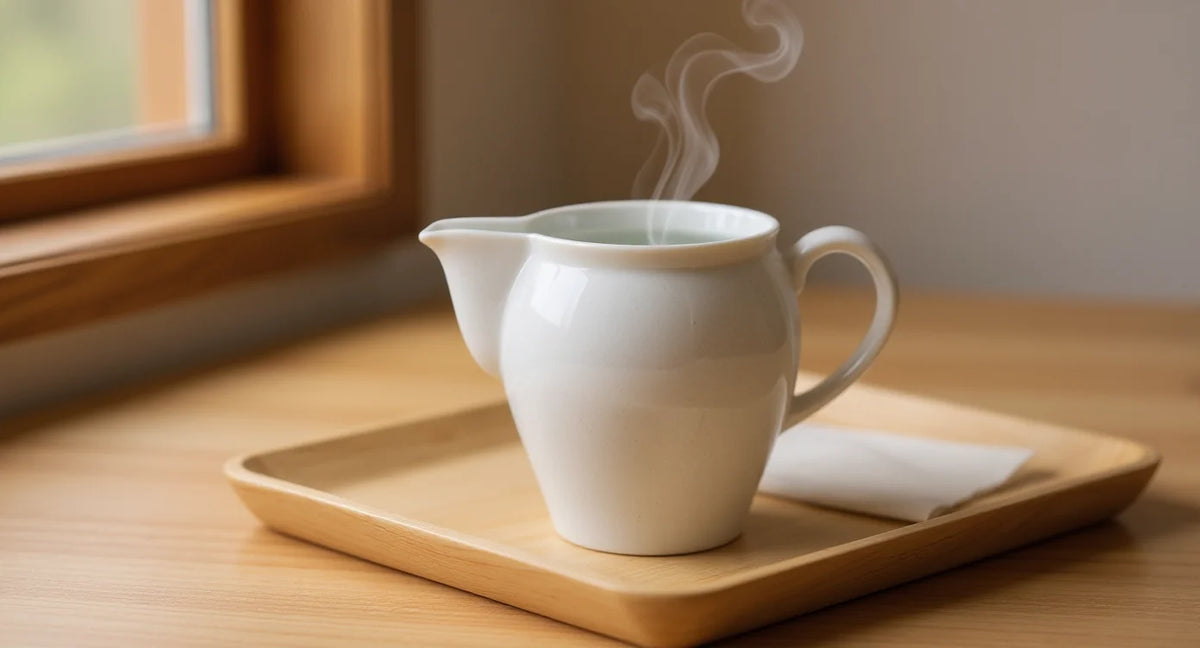
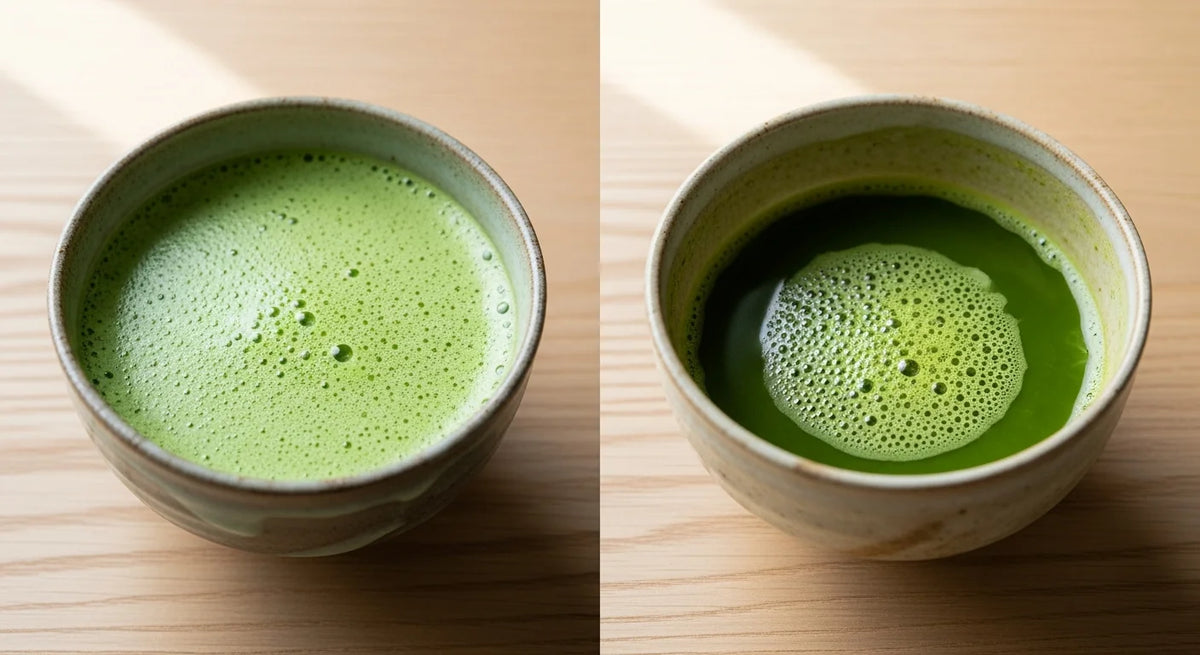
Arita porcelain is non-porous, smooth, and typically white or pale — characteristics that make it particularly well-suited to green tea. The non-porous glaze means aromas do not absorb into the vessel walls. The pale interior shows the colour of the liquor clearly: the difference between a light Shincha and a deeper autumnal Sencha is visible in a way that dark-glazed pottery does not allow.
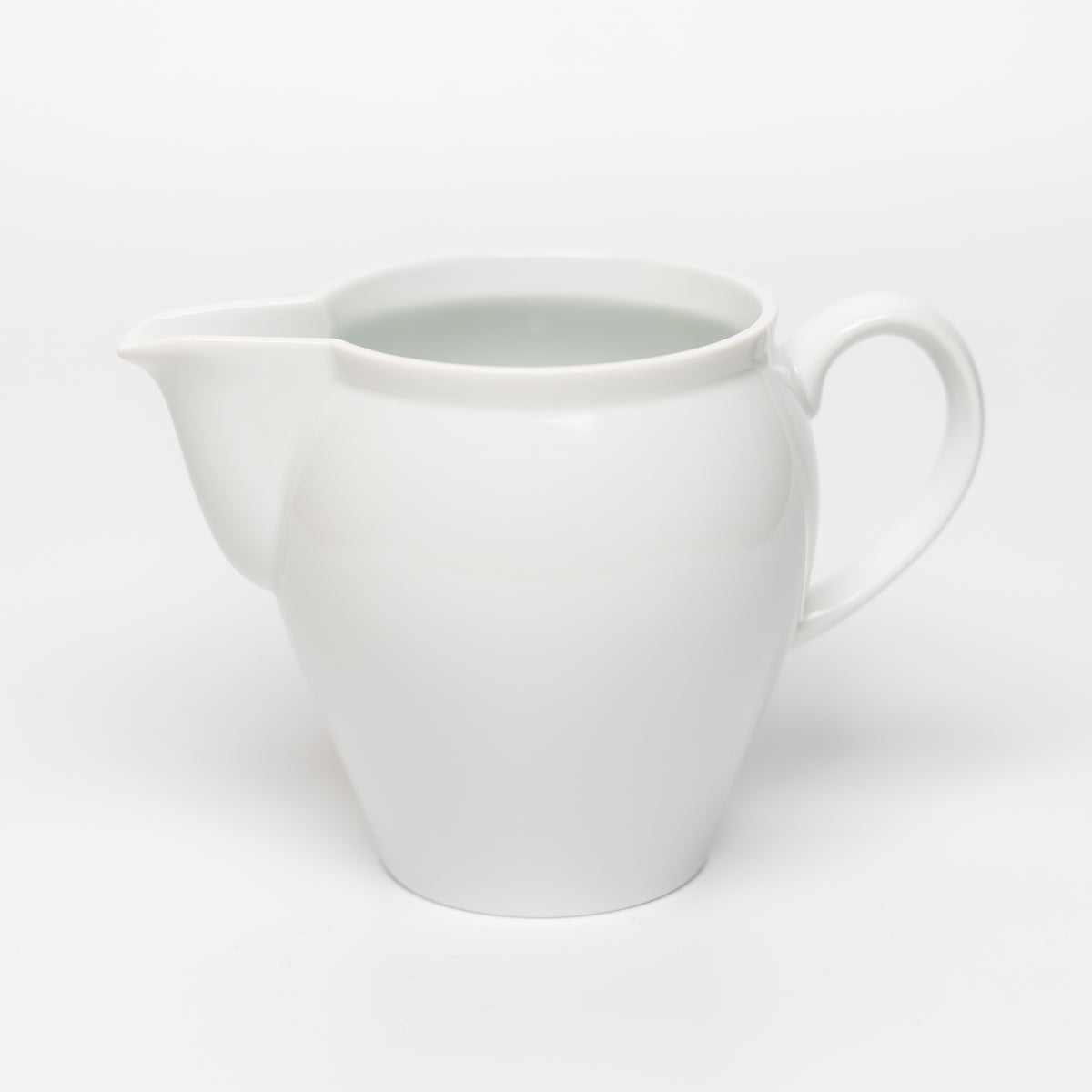
For formal tea settings, decorated Arita and Nabeshima pieces carry the right register of ceremony. For everyday Sencha, the plainer white Arita styles — sometimes called Arita-byakuji (有田白磁) — are practical and beautiful without demanding attention from the tea itself. The thin walls cool to a comfortable temperature for the lips quickly, which suits the shorter steeping and lower brewing temperatures of quality Sencha and Gyokuro.
Choosing and caring for Arita and Imari ware
When purchasing Arita ware, look for kiln marks (kamajirushi, 窯印) on the base. Reputable Arita kilns mark their work with the kiln's name or family crest. Well-known names — Kakiemon, Gen'emon, Imaemon — carry premium prices and a documented lineage. Contemporary Arita producers range from individual studio potters to larger factories; both can produce excellent work, but the provenance matters for price and collectability.
Most modern Arita porcelain without gold or enamel decoration is dishwasher-safe. The base material — dense kaolin porcelain — handles heat well, and the glaze is stable. Pieces with overglaze enamel painting (the coloured decoration applied over the glaze) should be hand-washed: the enamel is slightly softer than the underlying glaze and can be dulled by detergent or abrasive cycles.
Gold-decorated pieces — including authentic Old Imari and Kakiemon — should always be hand-washed. Gold burnished onto ceramic will dull with repeated dishwasher exposure.
To compare Arita-Imari with other Japanese ceramic traditions, see our Japanese teaware materials guide. For a different regional style — more rustic, less refined — Hasami ware offers an interesting contrast to Arita's polished aesthetic.
We carry a selection of Japanese porcelain teaware, including yunomi and kyusu suited to everyday Sencha and Gyokuro.
Frequently Asked Questions
Is Imari the same as Arita?
In production terms, yes — Imari ware is Arita ware that was shipped through Imari port. The clays, kilns, and potters are the same. In collector and connoisseur usage, "Imari" often specifically indicates the bold, layered export style (Old Imari, ko-Imari) made for the European market, while "Arita" is used more broadly for all production from the region. The terms overlap significantly and both are used in different contexts.
What is the difference between Kakiemon and Old Imari?
Both are Arita porcelain, but they represent opposite aesthetic philosophies. Kakiemon is restrained: sparse design, open space, soft colours on milky white. Old Imari is emphatic: dense decoration, bold red and gold, layered patterns filling the surface. Kakiemon was associated with connoisseur taste; Old Imari was made to impress in a European market that expected richness and colour. Both influenced European ceramics deeply, in different directions. To compare Arita-Imari with other Japanese ceramic traditions, see our Japanese teaware materials guide. For a different regional style — more rustic, less refined — Hasami ware offers an interesting contrast to Arita's polished aesthetic.