
Mie Prefecture produces more kabuse-cha than anywhere else in Japan. Roughly 70 percent of the national total. And almost no one outside the industry knows this.
The tea ships out in bulk, unnamed, absorbed into blends that carry other regions' labels. Most of it becomes "Uji tea" — a designation that, by official definition, covers leaves grown not only in Kyoto but also in Nara, Shiga, and Mie. Kyoto alone cannot fill its own demand. Mie makes up the difference, quietly, without credit. When I first learned this, I did not quite believe it.
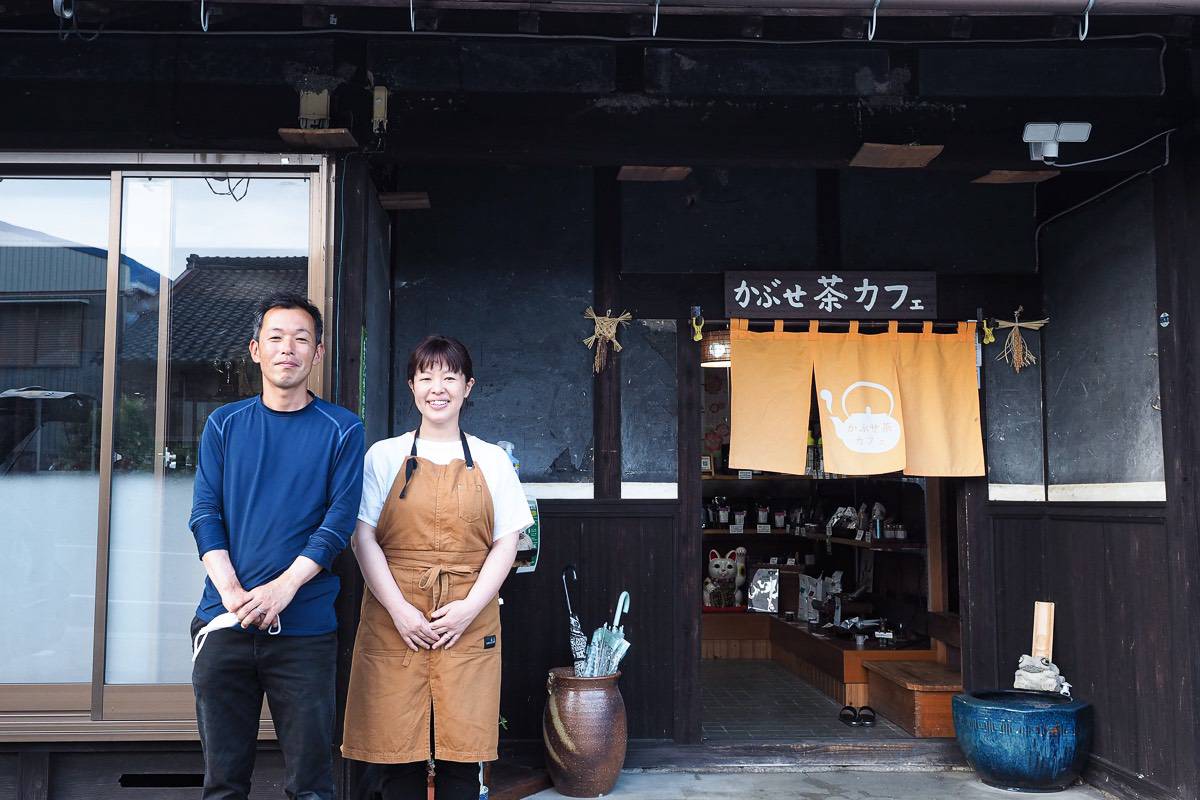
In the hills of Yokkaichi City, in a tea-growing district called Suizawa, a couple named Shimizu is trying to change the arrangement. Not by fighting the system — by stepping out of it entirely.
Suizawa, the district behind the curtain

Kabuse means "to cover." In the two to three weeks before harvest, black cloth is draped over the tea rows, cutting off sunlight. The plant, denied its usual energy source, responds by producing more chlorophyll and more theanine — the amino acid responsible for umami. Astringency retreats. Sweetness deepens. The leaf itself turns a dark, vivid green, almost emerald.
The result is a tea that sits between sencha and gyokuro — more depth than the former, less concentration than the latter. When the shading is timed well, the leaves develop a fragrance called ooika, a soft, almost floral sweetness unique to covered tea. Get the timing wrong, and the flavor turns heavy and dull. A narrow window.
Mie's tea farmers have mastered this technique for generations. But because the cultivar they overwhelmingly grow — Yabukita, which accounts for roughly 90 percent of the prefecture's output — is mild and blendable by nature, their leaves have always been destined for someone else's label. A tea designed to disappear.

"The attitude among tea wholesalers was all about color," Kana-san, the wife in the Shimizu partnership, explains. "How vivid is the green, how clean is the liquor. But customers — actual people drinking the tea at home — they choose by aroma and taste."
The disconnect between what the trade values and what drinkers value is the crack through which the Shimizus found their opening.
Saeakari, the cultivar that stayed
Marushige Shimizu Tea Factory sits partway up the hills of Suizawa-cho. The fields hold several cultivars, but one defines the farm.

Saeakari. Pour water over the deep green leaves and a sweet, corn-like aroma lifts from the cup — unexpected if you are used to the grassy sharpness of standard sencha. The first sip is round, almost creamy. Umami and sweetness spread across the palate together, unhurried, filling the mouth before gently tapering off. A tea you keep returning to because the flavor seems to shift each time you pay attention.

"Such a distinctive flavor is rare for kabuse-cha," a fellow producer in the region told the Shimizus. In a district where tea is bred for anonymity — quiet enough to vanish into a blend — Saeakari's character is precisely the point.
The cultivar exists on this farm partly by accident. Kana-san's father had planted a few uncommon varieties years earlier, almost on impulse. No one thought much of it at the time. It took years before the family recognized what he had left them.
Tea bushes need six to seven years before they yield a proper harvest. There is no shortcut, and no guarantee the field will survive. "We planted 6,000 Saemidori," Seiichi-san recalls. "3,000 of them died." Half the investment, gone. The ones that lived — those became the foundation.
A bakery, a tea shop, a department store in Shinjuku
The couple met in Tokyo. Kana-san worked at a specialty tea retailer inside a Shinjuku department store, selling leaves from producers all over Japan. Seiichi-san managed the bakery next door. He is from Tokyo. No farming background, no connection to Mie.
When Kana-san decided to return home and take over her parents' tea fields — a postwar family farm, tended carefully through the decades — Seiichi-san came with her.
A man who had never touched a tea plant, stepping into a community where everyone had grown up in the rows. The neighbors watched, probably skeptical. The couple learned as they went.

"I had no idea about management, really," Kana-san says. "But I could feel that if we did not start selling directly, we would not survive."
Being a newcomer, Seiichi-san says, turned out to help rather than hinder. The locals were generous — they taught him the machines, the rhythms of the season, the soil. Because he arrived knowing nothing, he had no assumptions to unlearn.
Sixteen years on, he is one of Suizawa's recognized producers. Someone whose read on the harvest other growers seek out.
Quantity, then quality

In 2020, government data showed that the purchase price of ichibancha — the year's first harvest, traditionally the most valued — had dropped below 2,000 yen per kilogram. The figure rattled the industry.
The cause was not a single failure but a structural drift. More people drink tea than ever, yet increasingly from plastic bottles rather than loose leaves. The leaf market has been shrinking year on year.
And within that shrinking market, farmers compete on speed — whoever ships first commands the highest price. The incentive is to grow fast and grow much, which pushes quality to the margins.

"What mattered for farmers was how much they could ship, not how good the tea was," Seiichi-san says. "Sell to a wholesaler, take whatever price you can get. I think that atmosphere is one reason the market declined the way it did."
The first-flush window has moved steadily earlier. Compared to when the Shimizus took over sixteen years ago, it has shifted by at least ten days.
Picking sooner means picking leaves that have not yet stored their full flavor — theanine still building, sweetness still developing, the character of the cultivar not yet fully formed.
As consumers, we want new things early. That impulse is honest. But tea, like most things worth waiting for, tastes better when it has had time to accumulate what it needs.
A 70-year-old house, a new idea
Ten years ago, the Shimizus converted an old folk house next to their factory into a cafe. Seventy years of wooden beams, tatami floors, the kind of space where time moves differently. They called it the Kabusecha Cafe.

Inside, guests settle onto the tatami and work through flights of single-cultivar teas — Saeakari beside Sofu beside Yabukita, each cup a different character from the same soil. There is kabuse-cha soda for those who want something lighter. The menu is an invitation to notice differences most people never get the chance to taste.

They host local school groups for factory tours. They run tea-picking workshops during the spring harvest. They set up booths at community events. The farm still supplies raw material to wholesalers — that remains the economic backbone — but more and more energy now flows toward standing face-to-face with the people who actually drink the tea.
"What I learned from opening the cafe and doing retail is that wholesalers and consumers want completely different things," Kana-san says. "Wholesalers judge by the color of the liquor — how vivid, how clean. But customers choose by aroma and taste. Once I understood that, everything changed."


Even now, after the cafe closes for the day, Kana-san and Seiichi-san will sometimes drive out to pop-up events or farmers' markets — setting out their teas, pouring cups, listening to what people notice. The wholesale business continues, but the conversation has widened.
A terrace in the tea fields
Sixteen years since they took over the farm. I asked what comes next.

"I have been thinking about building a terrace out in the tea fields," Seiichi-san says. "The climate here is pleasant — the air is good, the light is good. It would be nice if people could sit there, drink our tea, and look out over the rows. That is something only a tea farmer can offer."

I think about what Kana-san said — that customers choose by aroma and taste, not by the color of the liquor. It sounds simple. It is simple. But acting on it meant leaving behind the entire structure that had sustained Mie tea for decades.
A tea that spent decades vanishing into someone else's blend, now served under its own name in a cafe next to the factory where it was made. A couple who arrived from Tokyo with no farming background, now among the district's most trusted growers. The path from backdrop to center stage runs through 3,000 dead saplings, a father's impulsive planting, and the slow realization that the tea Suizawa had been sending away was, perhaps, too good to remain anonymous.


