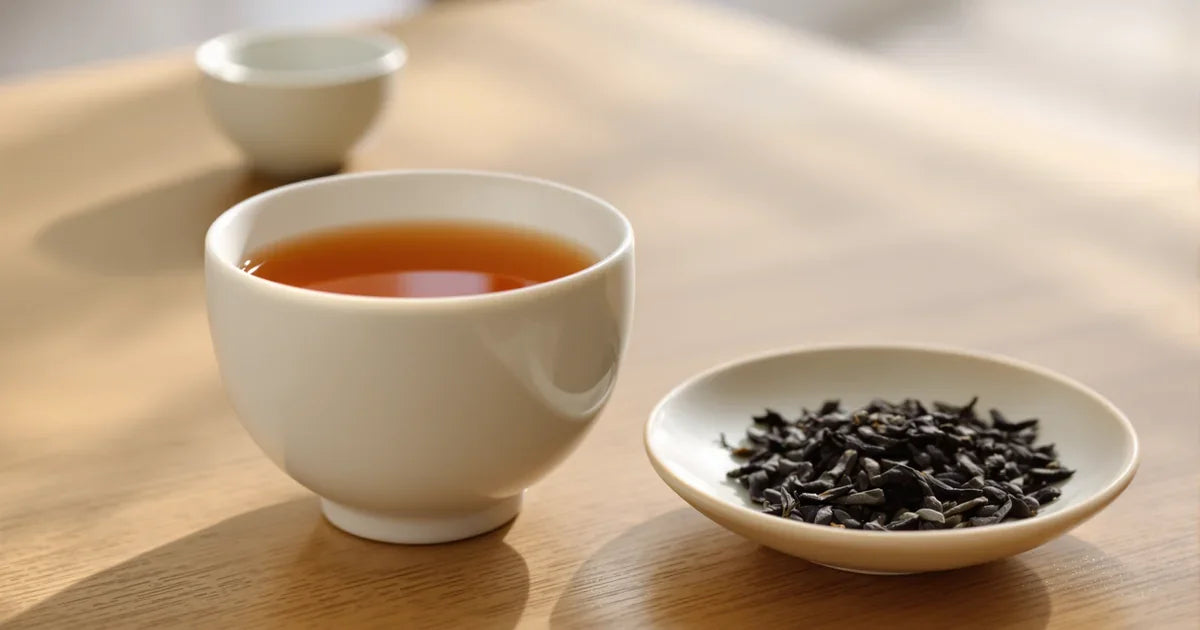

The powder looks the same in the photo. Bright green, finely milled, scooped into a bowl. One tin says Uji. Another says Hangzhou. Both say Matcha. The question most people are really asking is not whether one country makes better powder than the other. It is whether the green powder in the tin was made the same way.
Often, it was not. Japanese Matcha and Chinese Matcha can start from fundamentally different raw materials, follow different processing paths, and arrive at different results in the bowl. But the gap is narrowing in some categories, and pretending otherwise would be dishonest. We sell Japanese tea, so we have skin in this game. Our Behind the Sip articles record our visits to Japanese tea farms.
The short version: for traditional preparation — whisked in a bowl with water — Japanese Matcha remains the standard, and the reasons are specific. For lattes, baking, and smoothies, good Chinese Matcha can work well and often costs significantly less. The longer version requires looking at the leaf before it becomes powder.
| Attribute | Japanese Matcha | Chinese Matcha |
|---|---|---|
| Base leaf | Tencha (shade-grown, deveined) | Often non-Tencha leaf (unshaded or minimally shaded) |
| Shade period | 20-28 days (tana framework typical) | Varies (0-14 days common; top producers now 20+) |
| Grinding | Stone mill (30-40g per hour) | Ball mill or jet mill (kg per hour) |
| Cultivar | Named (Okumidori, Samidori, Gokou) | Rarely specified (changing) |
| Color | Vivid green | Often yellowish or dull green |
| Price range | $0.50-3.00 per gram | $0.10-0.50 per gram |
| Best for | Ceremony, usucha, premium drinks | Lattes, baking, smoothies |
The real difference is the starting leaf

Matcha, in the Japanese tradition, is ground Tencha. That distinction matters more than most labels suggest. Tencha is not ordinary green tea that has been pulverized. It is a leaf grown under shade for roughly 20 to 28 days, steamed to halt oxidation, dried flat rather than rolled, and then refined by removing stems and veins before the soft leaf material reaches a stone mill. The result is a powder designed from the field onward to be whisked into water and consumed whole.
Much of what is sold as Chinese Matcha starts from a different leaf. Some producers use leaf not produced through a Tencha-equivalent process, sometimes unshaded or only lightly shaded, ground in high-speed ball mills or jet mills that can process kilograms per hour rather than the few dozen grams a traditional stone mill yields. The powder can be fine, the color can be green, and the price can be very attractive. But the underlying tea was not built for the same purpose.
That is not a moral judgment. It is a processing fact. The Tencha pathway — deep shading, flat drying, vein removal, slow milling — exists because each step shapes the flavor, texture, and suspension quality of the final bowl. Skip or shorten any of them and the powder behaves differently in water. Our article on how Matcha and Tencha are made follows that pathway in more detail.

Where Chinese Matcha is genuinely improving
Saying "Chinese Matcha is always inferior" would have been closer to true ten years ago. It is less true now, and the trajectory matters.
Several Chinese growing regions have invested seriously in Matcha-style production. Enshi in Hubei province and parts of Fujian and Guizhou have moved toward longer shading periods, better cultivar selection, and more controlled milling. The domestic Chinese market for Matcha-based drinks has grown rapidly, and that demand is driving quality from within, not just for export.
A 2025 sensory and metabolomic study published in Foods (MDPI) compared Matcha samples from four Chinese growing regions against a Shizuoka reference sample, scoring them on flavor quality and non-volatile compound profiles. The Shizuoka sample scored 93.5. Enshi, the highest-scoring Chinese region, reached 90.7 — a gap, but not the chasm many tea professionals might expect. Wuyi followed at 89.1 (Wuyi is primarily known for oolong; its inclusion in the study is notable but it is not a major Matcha-producing region), Tongren at 86.5, and Hangzhou at 86.2. The study was funded by Chinese government agencies, and the Shizuoka sample still led, but the data suggests that the best Chinese producers are closing the gap on measurable quality indicators. (PMC11720590)
One important caveat: the sensory evaluation used a Chinese national standard (GB/T…23776-2018) with a brewing method — 0.6 g in a 240 mL bowl, 150 mL of boiling water, three minutes — that differs significantly from traditional Matcha preparation. The scores reflect relative quality under those conditions, not a direct measure of how the tea tastes when whisked in a bowl.
What that study measured, though, and what a tea drinker tastes in a bowl are not identical. Metabolomic profiles capture amino acid ratios, catechin levels, and volatile compound diversity. They do not fully capture mouthfeel, foam stability, or how the tea opens across three or four sips — qualities that also affect how caffeine and L-theanine interact in the cup. The numbers are real. The experience still tilts toward Japanese Matcha in ways that resist easy quantification.
There is also a transparency gap. Japanese Matcha producers frequently name their cultivar, their region, their harvest season, and sometimes the specific farm. Chinese Matcha labeling tends to be less detailed, which makes evaluation harder for buyers who cannot taste before purchasing. This is changing — some Chinese brands are beginning to list origin and cultivar — but it remains a meaningful difference in the current market. On the processing side, the leading Chinese Matcha producers have shifted to steaming — not pan-firing — having adopted Japanese-style equipment, which brings their oxidation-halting step closer to Japanese practice.
Japan's own export data reflects how global Matcha demand is pulling both countries forward. Japanese tea exports exceeded 10,000 tons in 2025 for the first time in 71 years, driven largely by Matcha. That surge means more production pressure on Japan, more price pressure from Chinese alternatives, and more reason for Chinese producers to improve if they want to compete at the upper end rather than only on cost.

What to look for when choosing Matcha — regardless of origin
Origin tells you something. It does not tell you everything. A poorly stored Japanese Matcha can taste worse than a fresh, well-made Chinese one. The most reliable evaluation happens in the bowl, not on the label. Here is what to pay attention to.
Color is the first signal. Good Matcha — from anywhere — should look vivid green, closer to spring leaves than to olive or khaki. A yellowish or brownish tint usually means less shading, older leaf material, or oxidation from poor storage. Color alone is not proof of quality, but dullness is a consistent warning sign.
Aroma comes next. Before you even add water, smell the powder. Matcha made from well-shaded Tencha often carries a scent somewhere between nori, fresh cream, and young edamame. If the powder smells like dried grass, hay, or nothing much at all, the leaf was probably not shaded long enough or has lost freshness since milling.
Foam tells you more than you might expect. Sift 2g of powder into a warm bowl, add about 60-70mL of water at 75-80°C, and whisk briskly — our Matcha preparation guide covers technique in detail. Then watch the surface. Finely milled Matcha from good Tencha tends to produce small, tight bubbles that hold together for a while. Coarser or poorly made powder often gives large, uneven bubbles that collapse quickly. The foam is not decorative. It reflects particle size and leaf quality.
Taste should move from umami into sweetness, with bitterness arriving only toward the finish if at all. If the first impression is sharp, metallic, or aggressively vegetal, the material was probably not built for drinking straight. That is not necessarily the tea's fault — it may perform well in a latte — but it tells you what you are working with.
Label information matters more than most people realize. Look for specifics: region of origin, cultivar name, harvest season, stone-milled or not, intended use (usucha, koicha, latte). The more a producer tells you about what is inside the tin, the more confidence you can have. When the label offers only "premium" or "ceremonial" without detail, caution is reasonable. Our guide to ceremonial grade Matcha explains why those terms alone are not enough.
Matching Matcha to how you use it
The most practical way to think about Japanese vs Chinese Matcha is not which is better in the abstract. It is which suits what you are actually making.
For koicha — thick tea, kneaded rather than whisked, where flaws have nowhere to hide — Japanese Matcha from a named cultivar, stone-ground, is the standard. This is not gatekeeping. Koicha requires a powder so refined that any roughness, bitterness, or inconsistency in particle size becomes immediately obvious. The concentration is too high for compromise. If you prepare koicha at home — and you have the right bowl, whisk, and scoop — this is where investing in the best Matcha you can find genuinely pays off.
For daily usucha — the lighter, foamier style most people mean when they say "a bowl of Matcha" — Japanese Matcha is still the recommendation, especially if you drink it straight. The umami depth, the foam quality, the finish that invites another sip rather than reaching for water: these come most reliably from tea made through the full Tencha pathway. That said, some upper-tier Chinese Matcha can produce a reasonable usucha, particularly if your preparation involves a touch of sweetener or if your palate prefers a brisker, more straightforward green profile.
For lattes and blended drinks, the calculation shifts. Milk, oat milk, and sweetener all modify flavor heavily. A robust, bold Matcha — even one with more bitterness and less umami refinement — can actually perform better in a latte than a delicate ceremonial powder whose subtlety disappears behind dairy. Good Chinese Matcha at a fraction of the price can do this job well. If you make Matcha lattes daily, using a $2.50-per-gram powder for that purpose is not an investment in quality. It is a waste of what makes that powder special. Our Matcha latte recipe walks through how to get the best color and flavor from latte-grade powder.
For baking, smoothies, and cooking, Chinese Matcha is often the practical choice. Heat, sugar, and fat all mute the nuances that justify Japanese Matcha's price. What survives is color, a baseline green tea flavor, and a pleasant bitterness that balances sweetness. A sturdy culinary-grade powder handles those jobs efficiently.
What we would not recommend is choosing Matcha based on price alone in either direction. The cheapest option is rarely a good value if you are drinking it straight, because the bowl will tell you immediately what was missing. And the most expensive option is rarely a good value if it is disappearing into a blender with banana and honey.
The right question is always the same: what am I asking this tea to do? Answer that first, and the origin question often answers itself.
If you want to explore what Japanese Matcha tastes like at different quality levels — from daily whisking to something more ceremonial — you can explore our Japanese Matcha collection.
Japanese Matcha and Chinese Matcha are not interchangeable, but they are not enemies either. They serve different roles at different price points, and the best choice depends on what ends up in the bowl — or the blender, or the oven. What matters most is understanding what you are buying and why. The leaf behind the label tells you more than the label itself.
If you are curious about what well-made Japanese Matcha tastes like across different grades and cultivars, our collection is a good place to start. Browse Far East Tea Company's Japanese Tea Collection.
Frequently Asked Questions
Can Chinese Matcha work well in drinks?
Yes. Good Chinese Matcha can work well in lattes, baking, and smoothies, often at a lower price. For traditional bowls whisked with water, we recommend Japanese Matcha.
Why is Japanese Matcha more expensive?
Japanese Matcha typically costs $0.50-3.00 per gram, against $0.10-0.50 per gram for Chinese Matcha, and it comes from a slower, more specialized pathway. Its Tencha is shaded for roughly 20 to 28 days, dried flat, and refined by removing stems and veins, then ground in a stone mill that yields only 30-40g per hour, while much Chinese Matcha is ground in ball or jet mills that can process kilograms per hour. Each step of the Tencha pathway shapes the flavor, texture, and suspension quality of the final bowl.
Does Chinese Matcha taste different from Japanese Matcha?
Generally, yes. Japanese Matcha made through the full Tencha pathway most reliably offers umami depth, foam quality, and a finish that invites another sip rather than reaching for water. Some upper-tier Chinese Matcha can make a reasonable usucha, particularly with a touch of sweetener or for a brisker green profile.
How can I tell if my Matcha is from Japan or China?
Check the label for specifics: region of origin, cultivar name, harvest season, and whether it is stone-milled. Japanese producers frequently name their cultivar and region, while Chinese labels tend to be less detailed, though this is changing.
What is Tencha, and why does it matter for Matcha quality?
Tencha is the specific type of tea leaf processed to become Matcha. It is shade-grown, steamed, dried flat rather than rolled, and refined by removing stems and veins. Only the soft leaf tissue goes to the stone mill. Each step shapes the flavor, texture, and suspension quality of the final bowl. Powder ground from leaf that was not processed as Tencha will behave differently in the bowl. Our article on Matcha and Tencha production covers the full process.
Which Matcha is best for lattes?
For lattes, a robust, bold Matcha can perform better than a delicate ceremonial powder whose subtlety disappears behind dairy. Milk, oat milk, and sweetener all modify flavor heavily, and good Chinese Matcha at a fraction of the price can do this job well. Our Matcha latte recipe walks through how to get the best color and flavor from latte-grade powder.