
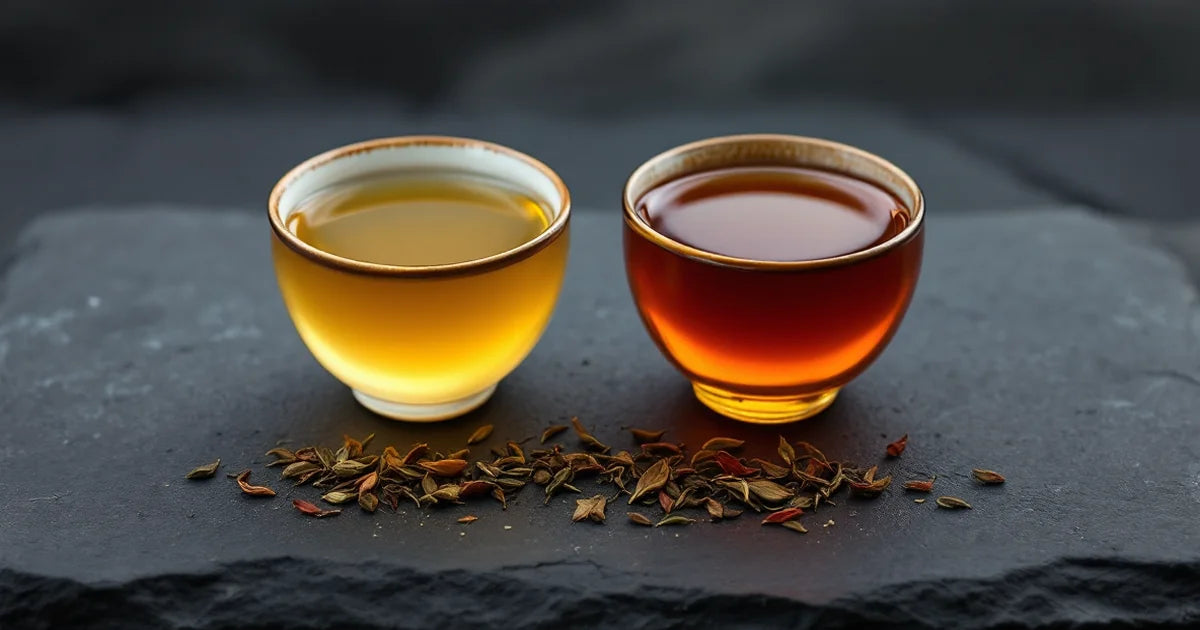
Pour a cup of lightly oxidized oolong and you get something floral, almost creamy — a pale gold liquor that smells of orchid and toasted grain. Pour a heavily oxidized one and the cup turns amber, the aroma shifts to caramel and dried fruit, and the flavor settles into something warm and roasty. Same category. Completely different experience.
We've tasted oolongs across that full arc — Taiwan high-mountain teas whose floral sweetness surprises people who think they don't like oolong, and Wuyi rock oolongs that carry mineral and dark-fruit notes even before the first sip.
That range is what makes oolong one of the most interesting teas to understand. It sits between green tea and black tea not just on a chart, but in every sensory dimension — flavor, aroma, color, and caffeine. Oxidation level is the variable that moves everything. Once you understand what oxidation does, the diversity of oolong styles stops feeling confusing and starts feeling logical.
What Is Oolong Tea
Oolong is a partially oxidized tea made from the leaves of Camellia sinensis — the same plant used for green tea, black tea, and white tea. The difference is in what happens after picking. Green tea leaves are heated quickly to stop all oxidation. Black tea leaves are rolled and left to oxidize fully. Oolong leaves are allowed to oxidize partway, then heating stops the process at a chosen point.
The oxidation range is wide: roughly 15% to 85%. Lightly oxidized oolongs, like certain Taiwanese high-mountain teas, stay close to the green tea end of the spectrum. Heavily oxidized styles, like Da Hong Pao from Wuyi, approach black tea territory. Most traditional Tieguanyin and Dong Ding fall somewhere in the middle — roughly 25% to 50% oxidized.
That number — the oxidation percentage — is not stamped on the package, and producers do not always agree on exact figures. But it is visible in the cup. Lighter oxidation gives green-gold liquor and floral, vegetal flavor. Deeper oxidation gives amber or reddish liquor and toasty, fruity, sometimes honeyed flavor. The leaf color follows the same pattern: green-edged leaves for light oxidation, reddish-brown for heavy.
In Taiwan and China, oolong is spelled without capitalization in standard English usage — it has been borrowed into the language long enough to function as a common noun. In Japan, the same tea is called 烏龍茶 (ūroncha), though domestic production of Japanese-grown oolong is small.
How Oolong Tea Is Made
The manufacturing process is more complex than that of either green or black tea, which is part of why skilled oolong producers are so respected. The sequence goes roughly like this:
Withering. Freshly picked leaves are spread outdoors (sun-withering) and then indoors to lose moisture and begin the oxidation process. The leaf softens and becomes pliable.
Bruising — the defining step. The leaves are repeatedly tossed or tumbled in baskets, which breaks down the leaf edges and creates sites where oxidation can occur. This is called yaoqing in Chinese tradition. The bruised edges oxidize faster than the interior, which is how oolong develops its characteristic "green leaf, red edge" appearance in some styles.
Partial oxidation. The leaves are left to oxidize at room temperature while being monitored. The producer decides when to stop — this is where craft and experience matter most. Too short and the tea stays grassy; too long and it loses its floral character.
Fixing (kill-green). Heat is applied — pan-firing or tumble-roasting — to halt oxidation at the chosen point. The enzymatic activity stops, and the flavor profile locks in.
Rolling and shaping. The leaves are rolled into their final shape, which varies by tradition: twisted strips for many Chinese styles, tightly rolled balls for Taiwanese styles like Dong Ding and high-mountain teas. The shape affects not just appearance but brewing: ball-style oolongs unfurl gradually, revealing different layers across multiple infusions, while strip-style oolongs open more quickly and are easier to brew in a single Western-style infusion.
Drying. Final moisture reduction. Some styles also undergo additional roasting at this stage — sometimes light, sometimes intense — to deepen flavor complexity, stabilize the tea for longer storage, and add the toasted grain or caramel character that defines heavily roasted styles like Dong Ding or Wuyi rock oolong. The roasting can also happen weeks or months after the initial production run, as a secondary finishing step applied by a tea master separate from the farmer.
For the full process with step-by-step detail, our guide to oolong tea manufacturing covers each stage and explains what goes wrong when the timing is off.
Types of Oolong Tea
The oolong category spans an enormous range of styles, mostly from Taiwan and China's Fujian and Guangdong provinces. Here is an overview of the major types, organized roughly from lightest to most oxidized.
| Name | Origin | Oxidation | Flavor profile | Liquor color |
|---|---|---|---|---|
| High Mountain (Alishan / Li Shan) | Taiwan | 12–20% | Floral, creamy, faintly sweet | Pale gold |
| Dong Ding (Frozen Summit) | Taiwan | 25–40% | Roasted, nutty, mellow, full-bodied | Golden amber |
| Tieguanyin (Iron Goddess) | Fujian, China | 15–50%* | Orchid floral (light) or roasted grain (heavy) | Gold to amber |
| Da Hong Pao (Big Red Robe) | Wuyi, Fujian | 60–80% | Mineral, roasted, dark fruit, caramel | Deep amber |
| Oriental Beauty (Dongfang Meiren) | Taiwan | 60–80% | Honey, peach, muscatel, spice | Amber-red |
| Phoenix Dan Cong | Guangdong, China | 40–70% | Fruity, floral, varies by cultivar | Amber gold |
| Japanese Oolong (Shizuoka / Miyazaki) | Japan | 20–40% | Delicate floral, light umami, clean | Pale to golden |
*Tieguanyin is produced in both a lightly oxidized "green" style popular since the 1990s and a traditionally roasted heavy-oxidation style. The style has shifted significantly in recent decades, so origin matters less than asking the producer about the oxidation and roasting level.
Oriental Beauty deserves a note: it is unique in being produced from leaves bitten by a specific leafhopper insect (Jacobiasca formosana). The insect's bite triggers the plant to produce terpenes as a defense response, which creates the tea's characteristic honey and muscatel complexity. It cannot be replicated on unbitten leaves.
Japanese oolong is still a niche category. Shizuoka and Miyazaki have both developed semi-oxidized styles over the past decade — typically lighter, with a clean character and subtle floral notes that reflect the Japanese terroir. Some farms in Shizuoka produce a semi-oxidized Hojicha variant that occupies an interesting middle space: the light roast character of Hojicha with the additional aromatic complexity of partial oxidation. Production of Japanese oolong remains limited, but the category is growing as farmers experiment with styles beyond the conventional green tea spectrum. For anyone who has explored Japanese green tea thoroughly, it is a natural next step worth trying.
What Does Oolong Taste Like
Oolong has the widest flavor range of any single tea category. At the light end, the profile is floral and creamy — orchid, lily, sometimes a soft honey note without any actual sweetness. The mouthfeel can be almost silky, and the finish is clean with very little astringency. These are the teas that surprise people who expect all oolong to taste like the heavily oxidized version they know from dim sum restaurants.
Moving into the middle range of oxidation, the character becomes fuller and more complex. Roasted grain, toasted nuts, a whisper of caramel. The floral notes recede and a rounder, more substantial body takes their place. These are the styles many people find easiest to drink — familiar enough not to challenge, interesting enough to hold attention.
At the heavily oxidized end, the profile shifts again: dark fruit, mineral depth, sometimes a faint smokiness. Da Hong Pao and other Wuyi rock oolongs fall here. The "rock" or yancha character is hard to describe without tasting it — a mineral backbone that seems to sit underneath the other flavors, giving the tea a kind of grounded quality.
Aroma compounds shift along the same spectrum. Lightly oxidized oolongs contain more of the volatile green-tea compounds (like (Z)-3-hexenol, which gives grassy, fresh-cut notes) alongside floral compounds such as geraniol and linalool. These are the same volatile molecules responsible for the scent of roses and coriander — the tea plant is producing them as aromatic attractants, and the light oxidation process concentrates rather than destroys them. As oxidation increases, these break down into more complex aromatic molecules — the ones responsible for honey, caramel, and fruity character. For a detailed breakdown of what is in the cup, our guide to oolong tea ingredients goes into the compound-level analysis.
Caffeine in oolong tea
A standard cup of oolong contains roughly 30 to 50mg of caffeine — lower than the same volume of Sencha or Gyokuro, but similar to or slightly higher than Hojicha or Bancha. The figure varies with brewing parameters: more leaf, hotter water, and longer steeping all push caffeine up. Gongfu brewing with multiple short infusions redistributes the caffeine across sessions rather than concentrating it in a single steep.
Oolong also contains L-theanine, the amino acid found across Camellia sinensis teas. L-theanine and caffeine interact in ways that some researchers describe as moderating the stimulant effect — a sustained alertness rather than a spike. Whether that effect is perceptible differs by person and context.
For the full caffeine breakdown by brewing method, water temperature, and infusion number, our dedicated oolong tea caffeine guide has the data table and practical guidance.
How to Choose an Oolong Tea
The easiest starting point is oxidation level. If you enjoy green tea — grassy, vegetal, refreshing — start with a lightly oxidized Taiwan high-mountain oolong or a floral-style Tieguanyin. The gap between these and green tea is smaller than you might think.
If you enjoy black tea or coffee — roasty, full-bodied, warming — start from the other direction. Dong Ding or Da Hong Pao will feel more familiar: substantial, layered, less delicate.
Shape also matters for brewing. Tightly rolled ball-style oolongs (most Taiwanese types) unfurl slowly over multiple steeps and work particularly well for gongfu brewing. Twisted strip styles (most Fujian types) open more quickly and are forgiving in western-style brewing.
Freshness matters more for lightly oxidized oolongs than for heavily oxidized ones. A heavily roasted Da Hong Pao can maintain quality for years when stored properly. A high-mountain floral oolong is best within six to twelve months of production. If you are buying online, check the harvest date.
Budget matters too — in a way that is worth being direct about. Cheap oolong in bulk bags at supermarkets is typically heavily roasted and blended, designed to taste consistent at the expense of complexity. Single-origin, small-lot oolong from a named farm and harvest season costs more and delivers something entirely different: the character of a specific place and time. If you are spending less than about $20 per 50g for a high-mountain Taiwan oolong, it is almost certainly not the real thing. That is not a snob point — it is a yield and labor point. The cost of producing hand-picked high-mountain tea cannot compress below a certain floor.
If you are ready to explore, you can browse our oolong selection — we source from Taiwan and Japan and note the oxidation level, harvest season, and farm for each tea.
How to Brew Oolong Tea
Oolong is forgiving — it tolerates a wider temperature range than Gyokuro and a wider leaf ratio than many green teas. Here are the basic parameters for two approaches.
| Method | Water temperature | Leaf amount | Steep time | Infusions |
|---|---|---|---|---|
| Western (mug or teapot) | 85–95°C | 3–5g per 200mL | 2–3 minutes | 1–2 |
| Gongfu (gaiwan or small teapot) | 90–95°C | 5–8g per 100mL | 20–45 seconds | 5–8+ |
Lightly oxidized oolongs (high-mountain, floral-style Tieguanyin) do better at the lower end of the temperature range — around 85–90°C — to preserve their delicate floral character. Heavily oxidized styles (Dong Ding, Da Hong Pao) can handle full boiling water and often benefit from it.
One note on gongfu brewing: the goal is not sheer strength but progression from one infusion to the next. Each short infusion reveals a different facet of the tea. The first steep often carries the floral or green character; later steeps reveal the body and sweetness. If you have never brewed this way, our oolong brewing guide walks through the technique step by step.
Oolong vs green tea vs black tea
All three come from the same plant. Processing is what separates them.
| Green tea | Oolong | Black tea | |
|---|---|---|---|
| Oxidation | 0% (unoxidized) | 15–85% (partial) | 85–100% (full) |
| Caffeine (per 100mL) | 15–50mg | 20–45mg | 25–60mg |
| Flavor | Vegetal, grassy, umami | Floral to roasty (range) | Malty, astringent, bold |
| Liquor color | Pale jade to golden | Gold to amber-red | Amber to dark brown |
| Brew temperature | 60–80°C | 85–95°C | 90–100°C |
| Best for | Light, clean cups | Complexity, multiple steeps | Bold, with milk or plain |
Green tea and oolong share the same plant genetics and many of the same health-relevant compounds — catechins, L-theanine, EGCG. The difference is in how processing transforms those compounds. Oxidation converts catechins into theaflavins and thearubigins, which changes both color and flavor. A heavily oxidized oolong begins to share more chemistry with black tea than with green.
If you are navigating the broader landscape of Japanese tea types, our Japanese green tea overview covers all the unoxidized varieties, and our guide to fermented tea explains the category beyond oxidized — the true fermentation that produces puerh and other aged styles.
Taiwan has the deepest oolong culture, and the history of how oolong traveled from Fujian to the island's high mountains — Alishan, Li Shan, Shan Lin Xi — is worth knowing. It shapes why Taiwanese oolong looks and tastes the way it does. Our history of Taiwanese tea covers that story, and the broader history of Chinese tea traces the origins of oolong production itself.
One practical thing that the comparison table above does not capture: the gap between green tea and oolong is smaller than the gap between oolong and black tea, in terms of the underlying chemistry. Green tea and lightly oxidized oolong share many of the same catechin and theanine compounds in similar proportions. The oxidation in a 15% oolong is modest — just enough to generate floral aromatic compounds without deeply changing the base structure of the leaf. By contrast, the 85%+ oxidation in black tea converts most of the catechins into theaflavins and thearubigins, changing the color, the astringency profile, and the flavor in a more fundamental way. This is why green tea drinkers often find their way to lightly oxidized oolong with little friction — but need a longer adjustment when they first try black tea.
The fermented tea category — puerh and related styles — is separate from all three of these and involves microbial activity rather than enzymatic oxidation. Our guide to fermented tea covers that distinction clearly.
For us at Far East Tea Company, oolong occupies a special place in the catalog precisely because of that range. It is the category where a single style of tea can meet a drinker exactly where they are — whether they are coming from green tea, from black tea, or from coffee — and offer something genuinely new without asking them to abandon what they already love. The same is true of the producers we work with: a Taiwanese farmer producing high-mountain oolong and a Japanese producer working with a semi-oxidized Hojicha-style tea are both doing something careful and considered, just from very different starting points. That range of intention is what makes oolong worth spending time with.