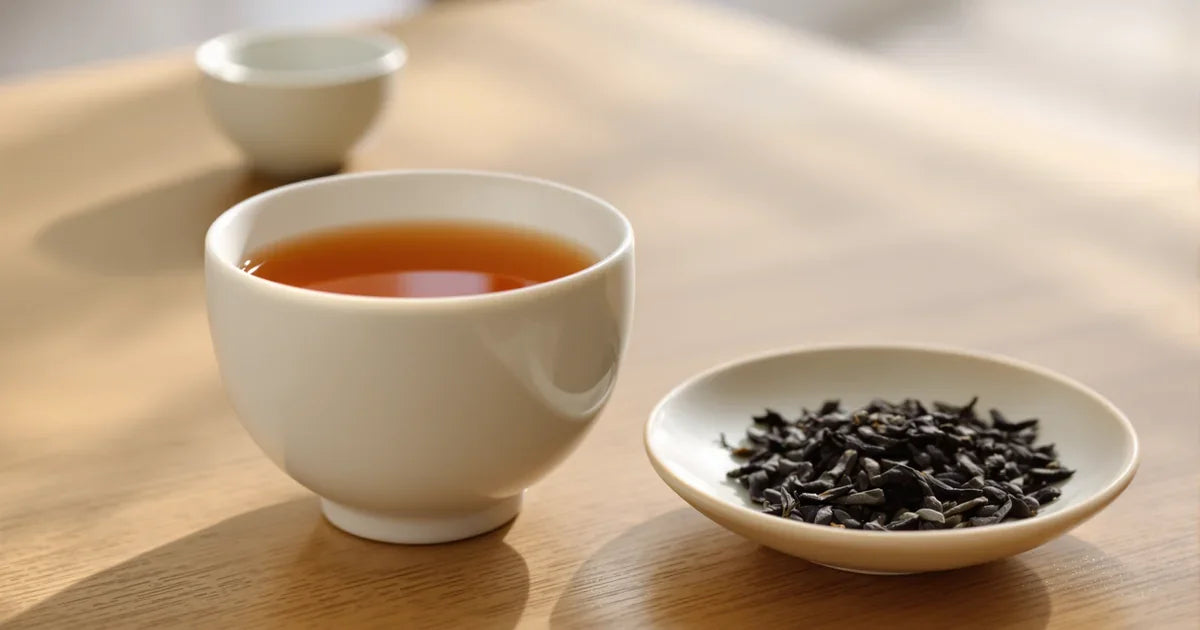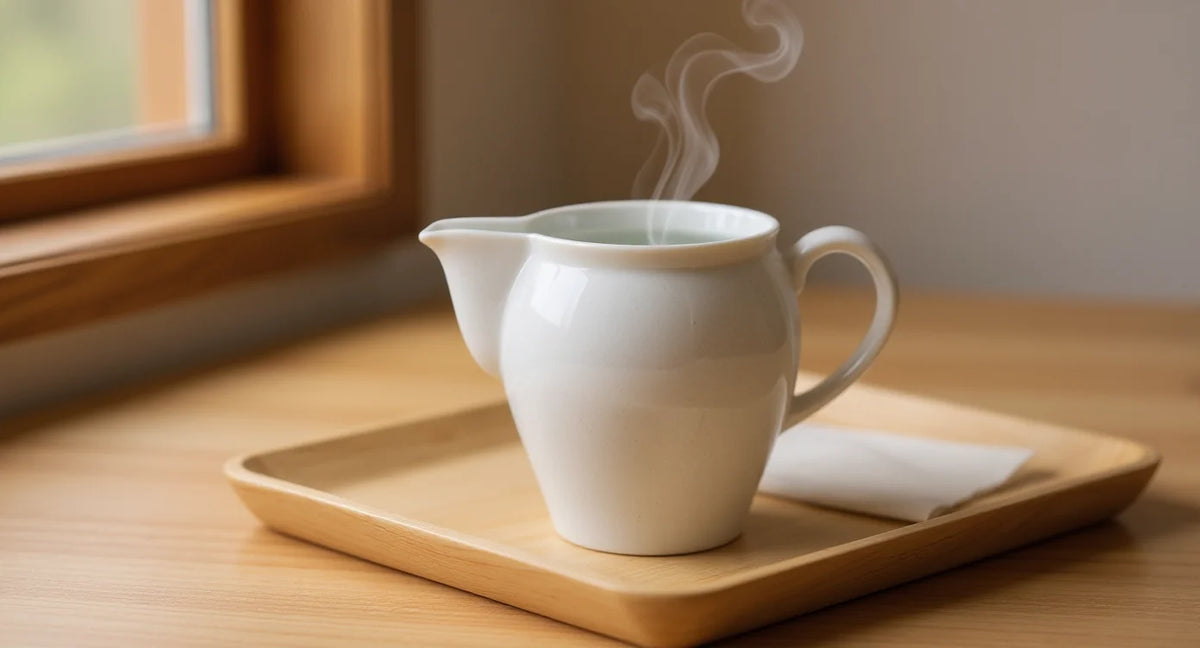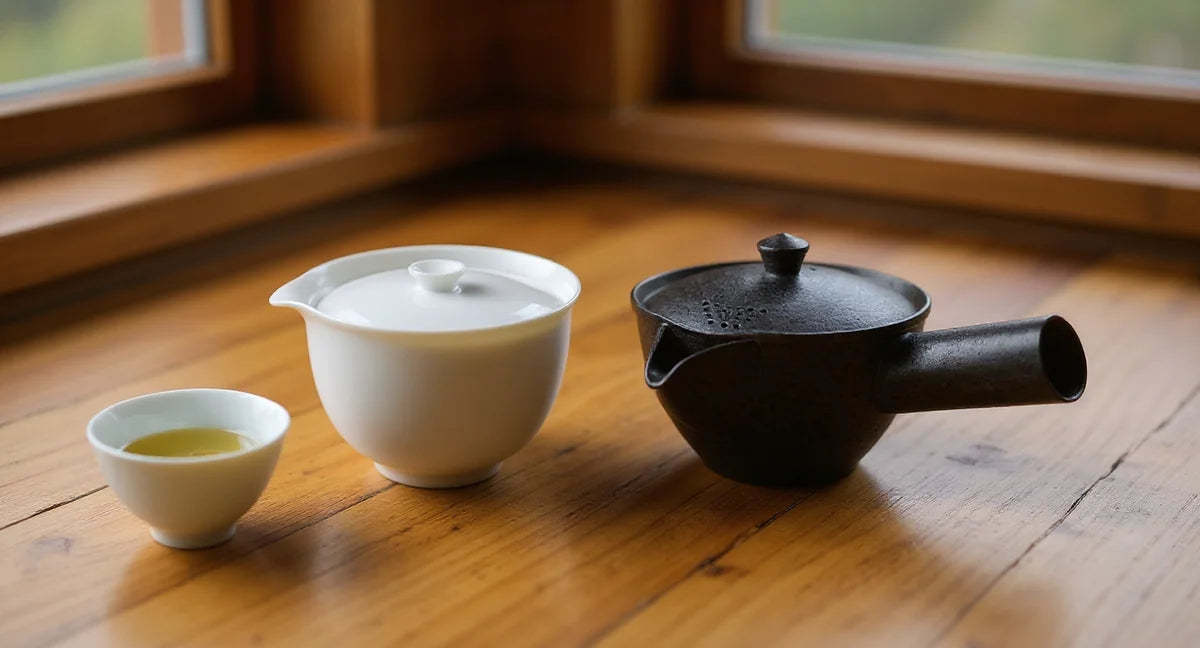

Brewed at a slightly lower temperature than you might expect, it pours a clear amber — lighter than Assam, less assertive than Darjeeling. The aroma carries rose and ripe stone fruit rather than the malt and briskness most black tea drinkers are used to. Japanese black tea — wakoucha in Japanese — is the same species, the same oxidation process, but a distinctly different result. It is one of the teas we return to at Far East Tea Company when we want something that rewards slow attention.
Wakoucha has existed since the Meiji period but spent most of the 20th century in decline. The modern revival, driven by small craft producers across Shizuoka, Kagoshima, Miyazaki, and Nara, has produced teas that win international recognition — and that offer something genuinely different from the Indian and Chinese black teas most of the world knows. This is not a footnote in global black tea history. It is its own category.
What is Wakoucha?
Wakoucha (和紅茶) is black tea produced in Japan from Japanese tea cultivars. The term combines wa (和, Japan) and koucha (紅茶, black tea). Romanization varies — you will also see "wakocha" without the extended vowel — but both refer to the same tea.
The distinction from imported black tea is not just geographic. Japanese tea cultivars were bred primarily for green tea production, which means they carry different flavor compounds than the Assam-type cultivars used for most of the world's black tea. When fully oxidized, they produce a liquor that is floral and gentle rather than malty and brisk — with less astringency, higher clarity, and a tendency toward fruity or honeyed notes that hold up well without milk or sugar.
This is fully oxidized tea by the standard classification. The leaf undergoes the complete sequence of withering, rolling, oxidation, drying, and sorting, and no green enzymes remain active in the final product. What makes it different from Assam or Ceylon is not the degree of oxidation but the cultivar it starts with — and the producer's decision about how to handle that cultivar's particular delicacy.
The compound profile of the finished tea reflects this. Where Assam-type black tea builds heavy theaflavin and thearubigin concentrations during oxidation — the compounds that create briskness and body — Japanese cultivars produce a lighter distribution of these pigments, resulting in a tea that is fully oxidized but softer in every dimension. The difference is analogous to the gap between a full-extraction espresso and a pour-over: both are coffee, but the extraction approach produces fundamentally different cups.
For the global picture of black tea by region — Darjeeling, Assam, Ceylon, Keemun — see our types of black tea guide. We've focused this guide entirely on the Japanese version.
The history of Japanese black tea
Japan began producing black tea seriously in the Meiji period (1868–1912), driven by government initiative to create an export product that could compete with Indian and Chinese teas on Western markets. Tea farms in Shizuoka and Kyushu received training and equipment from British and Indian specialists. By the 1890s, Japanese black tea was being exported to the United States and Europe in significant quantities — a fact that surprises most people who associate Japan exclusively with green tea.
The industry collapsed in the early 20th century. Japanese cultivars, bred for green tea and not for oxidation, struggled to match the flavor consistency of Assam-type competitors. The leaves are thinner and have lower polyphenol concentrations, which made producing a bold, brisk black tea consistently very difficult. After World War II, national focus shifted decisively back to green tea, and black tea production fell to negligible levels. By the 1970s, wakoucha was largely forgotten domestically.
The revival began quietly in the 1990s and accelerated through the 2000s. A new generation of producers — many of them younger farmers looking to differentiate their operations from the commodity Sencha market — began experimenting with full oxidation of Japanese cultivars, both purpose-bred varieties and green tea mainstays like Yabukita. The process required significant technical adjustment: the standard Indian and Sri Lankan approaches did not work well with Japanese leaf. Producers who succeeded did so by developing gentler, slower techniques suited to the cultivar's character. The establishment of the National Japanese Black Tea Grand Prix (*Zenkoku Wakoucha Grand Prix*) gave producers a competitive benchmark and began attracting press attention. International recognition followed, and wakoucha now appears in specialty tea shops across Europe, North America, and East Asia.
How Japanese black tea is made
The process shares the same sequence as any black tea: withering, rolling, oxidation, drying, and sorting. What differs is the approach taken at each stage to suit Japanese cultivars.
Japanese cultivars are delicate. They have thinner leaves and lower polyphenol concentrations than Assam-type plants. Producers tend to use a lighter withering — shorter duration, less moisture loss — to avoid stressing the leaf before rolling. The rolling itself is gentler, to avoid bruising the leaf too aggressively. Over-rolling with a thin-leafed cultivar releases excessive tannins that overwhelm the cultivar's natural floral character, producing a flat, harsh tea instead of the intended delicacy.
The oxidation phase is often shorter and conducted at a slightly lower temperature than in Indian or Sri Lankan production. Producers watch the leaf closely during this stage — the color change from green to copper signals oxidation progress, but with thinner Japanese leaves the window between under-oxidized (grassy, sharp) and over-oxidized (flat, empty) is narrower. Precision matters more here than in producing a robust Assam.
The result is a tea that is fully oxidized by the standard classification — no residual green enzymes — but that sits at the lighter end of the oxidation spectrum in terms of flavor impact. For the detailed process steps, see our article on the manufacturing process of oxidized tea. For how the compounds in the finished tea compare to other black teas, our black tea ingredients guide covers theaflavins, thearubigins, and the other compounds that form during oxidation.
Cultivars used for wakoucha
Cultivar is the single most important variable in wakoucha quality. Three categories are worth understanding.
Purpose-bred for black tea. Benifuuki, Benihikari, and Izumi were developed specifically for oxidized tea production. Benifuuki is the most widely planted; it produces a deep, floral liquor with distinctive muscatel notes. Izumi offers a softer, more delicate profile with a cleaner finish — closer to a pale, honey-inflected rose than the assertiveness of Benifuuki. These cultivars oxidize readily and produce consistent results — they are the foundation of the premium wakoucha market.
Green tea cultivars converted. Yabukita — which covered 64% of Japan's tea-growing area in fiscal 2025, according to Japan's agriculture ministry (MAFF) — can be processed as black tea with careful technique. The result is lighter and more variable than purpose-bred cultivars, but Yabukita wakoucha has a grassiness beneath the floral notes that some producers find appealing and some drinkers prefer for its familiarity. Sayamakaori and similar high-aroma green tea cultivars often produce interesting results when oxidized — the aroma compounds bred for green tea take on a different, sometimes richer character after oxidation.
Wild and local cultivars. Some small producers work with seed-propagated local varieties (*zairai*) that were never formally classified. The variability is higher, but so is the potential for unusual flavor profiles that cultivar-selected teas cannot produce.
| Cultivar | Primary use | Flavor notes when black tea |
|---|---|---|
| Benifuuki | Black tea (purpose-bred) | Muscatel, floral, slightly spicy |
| Benihikari | Black tea (purpose-bred) | Light, honey, gentle fruit |
| Izumi | Black tea (purpose-bred) | Soft rose, clean, low astringency |
| Yabukita | Green tea (converted) | Grassy, mild floral, variable |
| Sayamakaori | Green tea (converted) | High aroma, chestnut, sweet |
What Japanese black tea tastes like
Floral. That is the word that comes up most consistently, and it is accurate. Wakoucha tends toward rose, sweet pea, and ripe stone fruit — peach, apricot, sometimes lychee — with a clean finish that lacks the drying, tannic grip of high-extraction Assam or Ceylon. The cup is more elegant than bold. The scent opens before you bring it close; the flavor follows quickly and dissipates cleanly, without the heavy coating sensation some black teas leave behind.
The liquor is generally clear amber to copper, lighter in color than Indian or Sri Lankan black teas brewed at equivalent strength. Mouthfeel is lighter too — more elegant than full-bodied. Specific producers and cultivars vary considerably, and part of the interest in wakoucha is discovering how much range there is within the category. A Benifuuki from Shizuoka and a Yabukita from Kagoshima can seem almost like different types of tea.
| Tea | Origin | Typical flavor | Astringency | Best served |
|---|---|---|---|---|
| Wakoucha | Japan | Floral, honey, stone fruit | Low | Straight |
| Darjeeling (1st flush) | India | Muscatel, green-adjacent, floral | Medium-low | Straight |
| Assam | India | Malty, brisk, full-bodied | High | With milk |
| Ceylon (Uva) | Sri Lanka | Bright, brisk, slightly spicy | Medium-high | With or without milk |
Wakoucha sits closest to first-flush Darjeeling in the global black tea landscape — both are floral, both are best without milk, both have relatively low astringency. The difference is in the aromatic direction: Darjeeling's muscatel comes from its specific terroir and oxidation profile, while wakoucha's character comes from cultivar and the lighter, slower processing approach Japanese producers have developed.
Where Japanese black tea is produced
Wakoucha is made in scattered pockets across Japan, often by producers who also make green tea and treat black tea as a specialty line or a seasonal offering that allows them to use leaves that would be less suitable for the green tea grades.
Shizuoka is among the leading prefectures for wakoucha production. Shizuoka's established tea infrastructure and diverse microclimates make it a natural base for black tea experimentation. Benifuuki production is concentrated here, and several Shizuoka producers have built international reputations entirely around their wakoucha lines.
Kagoshima benefits from its warmer, more southern climate. Kagoshima producers have developed a reputation for smooth, accessible wakoucha that works well as an everyday tea. The warmer temperatures tend to produce a fuller, rounder cup than highland Shizuoka.
Miyazaki is smaller in production but has developed a distinct regional character — particularly from mountain-grown farms where cooler temperatures slow oxidation and build complexity. Miyazaki wakoucha from higher elevations can be among the most nuanced in Japan.
Nara, known historically for Yamato tea, hosts a small but active community of craft wakoucha producers. Local varieties adapted to the cooler inland climate give Nara wakoucha a somewhat different aromatic profile — slightly more restrained, with herbal undertones alongside the floral notes.
One characteristic across all these regions: most wakoucha is produced in small batches by farms that make it alongside their primary green tea lines. This means production volumes are inherently limited and quality control is artisanal rather than industrial. Single-estate and single-harvest labeling is common in the premium segment, and that traceability is part of what buyers pay for.
How to brew wakoucha
Higher temperature than Japanese green tea, but lower than most Indian black tea. Wakoucha's delicate cultivars over-extract easily — bitterness at high temperatures is the most common problem home brewers encounter, and it is entirely avoidable.
| Parameter | Wakoucha | Indian black tea (for comparison) |
|---|---|---|
| Water temperature | 85–90°C | 95–100°C |
| Leaf amount | 3g per 200mL | 3g per 200mL |
| Steep time | 2–3 minutes | 3–5 minutes |
| Serving suggestion | Straight (no milk) | With or without milk |
Wakoucha's floral notes are the first casualty of high-temperature over-brewing — the aroma lifts and disperses before the cup reaches the table, leaving a flat, tannic tea that gives no indication of the cultivar's character. Keep the temperature below 90°C and remove the leaves at the two-minute mark to preserve the delicacy that distinguishes it from commodity black tea. If you want a second steep, add 30 seconds to the time. Our guide to brewing black tea covers both Japanese and non-Japanese approaches in detail.
Wakoucha occupies a genuinely unusual position in the world of tea — a fully oxidized tea made in a country defined by its unoxidized teas, by producers who understand the green tea craft intimately and apply that precision to something different. That combination does not produce tea that tastes like anything else. For how this fits into the broader story of Japanese tea cultivars, see our guide to Assam-type and China-type tea plants. And if you have only ever bought black tea for its briskness and body, wakoucha offers a compelling reason to reconsider what black tea can be.
Frequently Asked Questions
What makes wakoucha different from Assam or Ceylon?
Wakoucha is fully oxidized like other black tea, but Japanese cultivars give it a clearer amber cup, lower astringency, and floral fruit notes rather than malt.
How should we brew wakoucha at home?
Use 3g leaf per 200mL water at 85–90°C for 2–3 minutes. Remove the leaves at the two-minute mark to preserve the tea's delicacy.
Which cultivars matter most for wakoucha?
Benifuuki, Benihikari, and Izumi are purpose-bred for oxidized tea. Yabukita and Sayamakaori can work too, but they need careful handling and vary more.
Why did Japanese black tea disappear and come back?
Japan exported black tea from the Meiji period, then production declined amid problems matching Assam-type flavor consistency and a postwar shift back to green tea. Small producers revived wakoucha in the 1990s and 2000s.
Does wakoucha taste better with milk or straight?
Wakoucha is best enjoyed straight. Its low astringency and floral, honeyed profile hold up well without milk or sugar.