
Steam rises from a metal drum. Inside, freshly picked tea leaves tumble through wet heat for twenty, maybe thirty seconds — just long enough to shut down the enzymes that would otherwise darken every leaf into oolong or black tea. This single step, applied within hours of harvest, is what makes green tea green. It preserves the catechins, the chlorophyll, the bright vegetal character that oxidation would convert into something else entirely.
Green tea is, at its core, tea where oxidation is stopped before it starts. Everything that follows — rolling, shaping, drying — serves the flavor that decision protects.
What makes green tea unoxidized
All tea comes from the same plant, Camellia sinensis. The difference between green tea and black tea is not the leaf — it is what happens after picking. In black tea production, the leaves are withered and rolled to encourage oxidation. In green tea production, heat is applied as quickly as possible to deactivate polyphenol oxidase, the enzyme responsible for that oxidative chain reaction.
This heat step is called sassei in Japanese — literally "kill the green," though what it really stops is enzymatic activity. Two methods dominate:
Japanese green tea uses steam. The leaves pass through a steaming drum within hours of harvest, producing a tea that tends toward vivid green color, vegetal sweetness, and a clean marine quality. Chinese green tea is typically pan-fired in a hot wok, which gives the leaf a drier, slightly toasty character with more nutty and floral notes. In Japan, Kamairicha preserves this pan-fired approach as the principal surviving lineage — a rare Kyushu tradition that bridges the two processing philosophies.
Because oxidation is halted so early, green tea retains more of the leaf's original chemistry. Catechins — particularly EGCG — stay largely intact. Theanine, the amino acid behind umami and calm focus, remains at higher levels than in oxidized teas. Chlorophyll survives, which is why the liquor stays green-gold rather than turning amber. The manufacturing process is designed, from start to finish, to protect what the fresh leaf already contains. For the opposite approach, see our guide to the manufacturing process of oxidized tea.
The Japanese green tea process step by step
Japanese green tea production follows a sequence refined over centuries: steaming, rolling in several stages, drying, and finishing. Each step builds on the last. Rushing one throws off the next.
Steaming
The process begins with steam. Freshly harvested leaves enter a steaming drum where they are exposed to pressurized steam — typically for 30 to 40 seconds in standard Sencha production. The goal is to deactivate oxidative enzymes evenly without cooking the leaf. Uneven steaming produces tea with inconsistent color and off-flavors.
Temperature and duration at this stage set the character of the finished tea more than any other single variable. Shorter steaming preserves more of the leaf's structure and aroma. Longer steaming softens the leaf, mutes astringency, and deepens the color of the brewed cup.
Rough rolling

After steaming, the leaves are kneaded under pressure while hot air circulates through the drum. This serves two purposes: it begins reducing moisture, and it starts breaking down cell walls so the tea's flavor compounds can be extracted more easily during brewing. The leaves emerge softer, with their moisture dropping from around 75 percent to roughly 50 percent.
Rolling and twisting

Rough rolling alone does not distribute moisture evenly through the leaf. In this stage, pressure is applied without heat, working the leaves to equalize their internal moisture and further break open cell structures. This step ensures that the tea's components — catechins, amino acids, caffeine — will dissolve readily when hot water hits the leaf.
Medium rolling and fine rolling

Medium rolling continues the kneading with warm air, preparing the leaves for their final shape. Fine rolling is where Sencha gets its characteristic needle-like appearance. The leaves are rubbed in one direction under controlled pressure, elongating and tightening them into thin, dark-green needles. This shape is not just aesthetic — tightly rolled leaves release their flavor more gradually during brewing, giving the drinker more control over extraction.
Drying

After fine rolling, the leaves still contain 10 to 13 percent moisture. Hot air drying brings this down to around 5 percent, stabilizing the tea for storage and transport. At this point, the tea is called aracha — crude or unfinished tea. It has the shape, the color, and the basic flavor profile, but it has not yet been refined.
| Step | Duration | Temperature | Purpose |
|---|---|---|---|
| Steaming | 30 to 40 seconds (standard Sencha) | ~100 degrees Celsius (steam) | Deactivate enzymes, preserve green color |
| Rough rolling | 30 to 40 minutes | Warm air circulation | Reduce moisture, begin cell breakdown |
| Rolling / twisting | 15 to 20 minutes | No heat | Equalize moisture, open cell structure |
| Medium rolling | 20 to 30 minutes | Warm air | Further kneading, prepare for shaping |
| Fine rolling | 30 to 40 minutes | Controlled pressure | Shape into needles, promote even drying |
| Drying | 20 to 30 minutes | 80 to 90 degrees Celsius | Reduce moisture to ~5%, create aracha |
Steaming depth matters
Not all Japanese green tea is steamed for the same duration, and the difference is not subtle. Steaming time is one of the most consequential decisions in Sencha production. It determines the leaf's structural integrity, the color of the brewed cup, and the balance between astringency and sweetness.
Standard Sencha uses what is called asamushi — light steaming, around 30 seconds. The leaf holds its shape well through rolling, producing tightly formed needles that brew into a clear, pale-green liquor with a balanced interplay of sweetness, astringency, and aroma. The flavor tends to be bright and clean, with a refreshing quality that lingers.
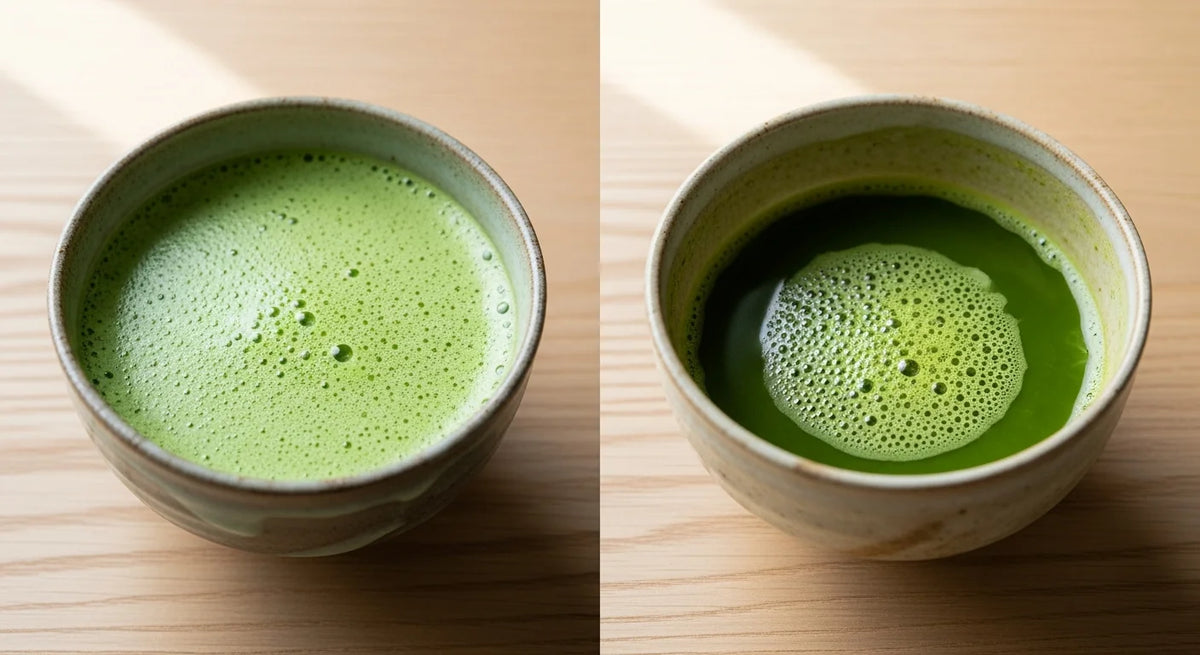
Fukamushi Sencha — deep-steamed Sencha — is steamed for two to three times longer, roughly 60 to 90 seconds. This extra time softens the leaf so thoroughly that it breaks apart more during rolling, producing smaller, finer particles. The result is a tea that brews quickly into a deep, opaque green liquor with more sweetness and markedly less astringency. More of the leaf's soluble content enters the cup because the smaller particles have greater surface area in contact with water.
The trade-off is straightforward. Light steaming preserves more of the leaf's aromatic complexity and produces a more translucent, elegant cup. Deep steaming sacrifices some of that clarity for sweetness, body, and ease of brewing. Neither is better. They are different expressions of the same leaf. For a deeper comparison of Sencha styles including Fukamushi, see our guide to Sencha. If you want to get the most out of either style, our Sencha brewing guide covers water temperature and steeping times for both.
From aracha to finished tea

The aracha that leaves the factory is not yet the tea you buy. It contains stems, dust, irregularly shaped pieces, and slightly more moisture than is ideal for long-term storage. The finishing process transforms this raw material into a consistent, shelf-stable product.
First comes sorting and sifting. The aracha passes through sieves that separate leaves by size and remove fine stems and dust. The tea is then cut and shaped to achieve a uniform appearance.

Then comes hi-ire — final firing. The sorted leaves are heated one last time, using direct heat, hot air, far-infrared rays, or microwaves. This step does more than preserve the tea. It develops aroma. The temperatures and duration of firing are where a tea master's signature often shows. A lighter firing preserves freshness. A stronger firing brings out toasty, almost caramelized notes. The same aracha, fired differently, becomes a noticeably different cup.

Finally, blending. Different batches, even from the same field, vary in flavor. Blending equalizes the composition and quality, producing a consistent product. A skilled blender draws from dozens of lots to create a tea that meets a specific flavor profile — not averaging out the good and the bad, but combining complementary strengths.
Fresh leaf becomes aracha in less than a day. The finishing — sorting, firing, blending — follows at a separate facility. Together, those steps turn a perishable agricultural product into the stable, flavorful tea that reaches your cup.
We find the manufacturing process most revealing when we can taste its fingerprints. A Sencha with a clean marine note and bright green liquor was steamed quickly and fired lightly. A deep-steamed Sencha with an opaque green cup tells a different story — longer heat, finer particles, more of the leaf dissolving into water. The process is not something that happens before the tea gets interesting. It is where the interest begins.
If you are curious about how shading before harvest changes what the factory receives, our article on covered cultivation explains how blocking sunlight shifts the chemistry of the fresh leaf — more theanine, more chlorophyll, less catechin — before manufacturing even starts. And for teas where shading and processing combine to create something entirely distinct, see our guides to Gyokuro and Matcha and Tencha. If you want to compare that with the opposite logic, our guide to the manufacturing process of oxidized tea follows what happens when oxidation is encouraged rather than stopped.
Frequently Asked Questions
What makes green tea unoxidized?
Green tea is heated within hours of harvest to deactivate polyphenol oxidase before oxidation can darken the leaf. That early heat keeps the liquor green-gold and preserves fresh vegetal aroma.
Why does Japanese green tea use steam instead of pan-firing?
Japanese tea usually passes through a steaming drum, often about 30 to 40 seconds for standard Sencha. Steam gives a vivid green color, marine aroma, and vegetal sweetness.
How do rolling steps change the flavor in the cup?
Rough rolling lowers moisture from around 75 percent to roughly 50 percent, while twisting and fine rolling open cell walls and shape needles. That helps catechins, amino acids, and caffeine dissolve readily during brewing.
Why does deep-steamed Sencha taste different from light-steamed Sencha?
Fukamushi is steamed roughly 60 to 90 seconds, two to three times longer than light-steamed Sencha. The softer leaves break into fine particles, brewing quickly with more sweetness and less astringency.
How can production choices affect tea quality or flavor?
Uneven steaming can cause patchy color and off-flavors, while firing changes aroma from fresh to toasty. Blending also matters because we combine lots to keep quality consistent without flattening character.