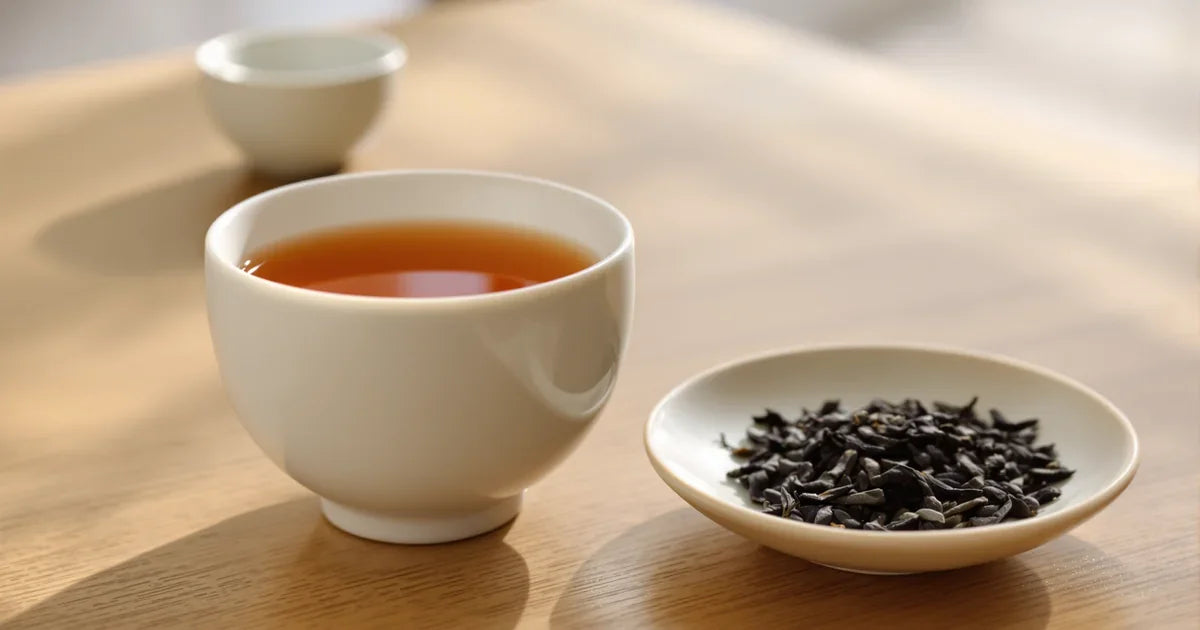

When you weigh green tea vs black tea, start with the plant: both, along with oolong, come from what Japan's Ministry of Agriculture, Forestry and Fisheries (MAFF), in its April 2022 feature on tea types (in Japanese), calls “basically the same kind of tea plant,” Camellia sinensis. The three teas are classed by how far the picked leaf oxidizes: green tea is heated at the start to stop its enzymes, oolong is stopped part-way, and black tea oxidizes fully before heat is applied at the final stage. Growing and processing add range within each one. At Sugita Tea Farm in Makinohara, Shizuoka, Benifuuki is made into black tea: the cultivar is rich in catechins and comes out strongly astringent as a green tea, but as a black tea it turns fragrant, with its astringency in balance.
A side-by-side table traces heat, rolling and air through green, oolong and black tea. Taste, caffeine in test brews, and Japanese growers follow.
Green tea vs black tea vs oolong at a glance
In processing terms, green tea, oolong and black tea are classed by when heat stops the leaf's enzymes: at the start for green tea, part-way for oolong, and at the final stage for black tea. MAFF places oolong between about 15% oxidation, close to green tea, and about 70%, very close to black tea. Cultivar, cultivation and roasting widen the range within each class.
The table below follows each leaf from manufacture to the compounds and caffeine in a brewed tea.
| Green tea | Oolong | Black tea | |
|---|---|---|---|
| Oxidation | Stopped by heating at the very start | Stopped part-way, from about 15% (close to green tea) to about 70% (very close to black tea) | Allowed to run its course; heated only at the final stage |
| Key steps | Steamed (the usual method in Japan) or pan-fired, then rolled and dried | Withered, pan-fired to stop the enzymes, rolled and dried; roasting adds another variable | Withered, rolled to break the leaf cells, oxidized, then dried |
| Color of the leaf | Green; early heating keeps the leaf green | Changes with the degree of oxidation | Reddish-brown; heating waits until the final stage |
| Polyphenol changes | Catechins remain as early heat stops the enzymes | Some leaf polyphenols oxidize | Catechins become theaflavins and thearubigins |
| Caffeine per 100mL, MEXT test brew (leaf / water / temperature / time) | 20mg (Sencha: 10g / 430mL / 90°C / 1 min) | 20mg (15g / 650mL / 90°C / 30 sec) | 30mg (5g / 360mL / boiling / 1.5–4 min) |
| A Japanese example | Sencha | Kanayamidori, Kohshun (cultivars MAFF lists as suited to oolong) | Japanese black tea, or wakoucha, such as Benifuuki |
The processing rows draw on MAFF's April 2022 feature. The caffeine figures come from MAFF's caffeine page listing Japan's Standard Tables of Food Composition 2020 (8th revised edition), published by MEXT, the education ministry (in Japanese). Each figure describes its own brew under the conditions in its cell, so the row gives no general strength ranking. The 90°C shown for Sencha is a test condition; water temperatures for everyday brewing appear below.
What happens to the leaf after picking
After picking, the order of heat, rolling and exposure to air determines how long the leaf's own enzymes can work: heat stops them, while rolling breaks the leaf's cells so the enzymes meet oxygen. The Shizuoka prefectural tea industry association's FAQ on green, black and oolong tea (in Japanese) places the three teas along that line, from early heating for green tea through an intermediate stop for oolong to extended oxidation for black tea.
Green tea, heated first
Green tea meets heat in the first stage of manufacture. The heat stops the enzymes in the fresh leaf and preserves its green color. In Japan, the usual way to apply it is steam; Shizuoka's prefectural tea industry association describes steaming as a distinctly Japanese method. The leaves can then be rolled while heated and shaped as they dry, as they are for Sencha.
MAFF's April 2022 feature calls Sencha the tea Japan produces most. Kamairicha takes another route: it skips steaming, is fired in a pan at about 300–400°C and is made mainly in Kyushu, in southwestern Japan, according to MAFF. Shizuoka's association also describes pan-firing in parts of Kyushu and in China.
Oolong, stopped part-way
Oolong leaves are withered, then pan-fired to stop the enzymes part-way through oxidation. Rolling and drying follow the heat; by then the leaf has already had its time in the air. MAFF's home method shows the order in familiar terms: fresh leaves wilt first in the sun and then indoors, are fired on a hot plate, rolled by hand and dried at a lower heat, about 95°C. MAFF says anyone with fresh tea leaves can make both oolong and black tea at home.
The point where heat goes in can fall anywhere within MAFF's range of about 15% to about 70%. Roasting gives the maker another choice after that stopping point: MAFF describes heavy, medium and light firing.
Black tea, oxidized to the end
Black tea leaves are withered and then rolled, breaking their cells. The leaf's enzyme, polyphenol oxidase, meets oxygen; catechins are converted into theaflavins and thearubigins. Heat comes at the final stage, after the leaf has been allowed to oxidize fully.
When we visited Imura Tea Farm in Shimada, Shizuoka, for our 2021 profile, the factory was in the middle of making black tea. Freshly picked Yabukita, a cultivar also used for green tea, was withered, rolled in a machine and left to rest as it oxidized; the bright green leaves turned reddish-black. A fruity, apple-like aroma mixed with the freshness of green leaves in the factory air.
MAFF calls black tea “fully fermented tea,” but what actually happens is tea oxidation, driven by the leaf's own enzymes, with no microbes involved. Microbial fermentation belongs to post-fermented teas: heat first stops the leaf's enzymes, then microbes such as molds and bacteria ferment it. Examples include Pu-erh and, from Japan, Goishicha and Awa Bancha. In the usual green-tea process, heat comes first and stops oxidation before it develops; MAFF labels the tea “unfermented.”
Is oolong a green tea or a black tea?
Oolong is neither: it is its own semi-fermented category. MAFF puts its oxidation anywhere from about 15%, close to green tea, to about 70%, very close to black tea; Shizuoka's prefectural tea industry association calls it midway between unfermented and fermented tea. MAFF also gives the category another name: “blue-green tea” (青茶).
If you are comparing green tea vs oolong tea, watch what happens before the first heat. Green tea is heated at once to stop its enzymes; oolong is first withered and left to oxidize, and only then does the maker apply heat.
With oolong vs black tea, the question becomes how long oxidation runs. Black tea oxidizes fully before its final heating, while oolong's maker stops the process part-way and may roast the leaf afterward, changing its flavor and aroma further. That range of stopping points and roasting choices makes oolong tea a broad category, even before cultivar and growing practice come in.
White tea, yellow tea and dark, post-fermented tea sit beyond this comparison. Only post-fermented tea is fermented by microbes, and MAFF describes it as made by a method different from all three. So a “fermented” label makes more sense once you know how tea is made in each case.
How green, black, and oolong tea taste
MAFF describes Sencha as moderately astringent with a fresh aroma, and Kamairicha as less astringent, refreshing and toasty. Japanese black tea, wakoucha, has a gentle sweetness and clean taste. Oolong's flavor and aroma vary widely with both its degree of semi-fermentation and its roasting, as MAFF's Ocha Taikoku Nippon guide to Japanese tea (in Japanese) explains.
Sencha and Kamairicha are both green teas, so a label that says only “green tea” does not tell you which taste to expect. On the black tea side, Shizuoka's prefectural tea industry association describes an oxidizing leaf as wilting, browning and giving off a sweet smell. For oolong, MAFF notes that Japanese semi-fermented teas are known for a bright, expressive fragrance, and our 2021 profile of Hiraoka Tea Farm describes the farm's Musashikaori oolong as having a fruity aroma.
Which one should you choose?
If you enjoy moderate astringency with a fresh aroma, Sencha is a good place to start. MAFF pairs cold Sencha with spicy curry, where that fresh character can sit beside the food's seasoning. For a gently sweet cup alongside a meal or dessert, try wakoucha: MAFF suggests serving it with roast beef, with fruit, or with apples and cream cheese.
Oolong gives you room to choose by aroma and roasting. MAFF's description runs from the bright fragrance of Japanese semi-fermented tea to the toastiness that firing can add. The name itself leaves those choices open; asking how the leaf was roasted gives you a more useful taste clue. If you lean toward green tea, the types of Japanese tea run well beyond Sencha and Kamairicha.
Water temperature for each tea
For Sencha, including lightly steamed and deep-steamed Sencha, and for Kamairicha, MAFF's everyday brewing guide suggests 70–80°C water and 30 seconds to 1 minute of steeping. Black tea gets 90–100°C, and Gyokuro, for contrast, 50–60°C.
MAFF's list leaves oolong out, so for that tea, check our tea brewing temperature guide.
Caffeine and health, the short version
The caffeine figures in the table come from Japan's Standard Tables of Food Composition 2020 (8th revised edition), as listed by MAFF. Each tea was brewed with its own amount of leaf, water, temperature and time, so each figure belongs to that test brew. On health, the three teas carry different polyphenols: green tea retains its catechins, while black tea's catechins are converted into theaflavins and thearubigins.
Caffeine numbers come with brewing conditions
With a different recipe behind each figure, the table cannot rank the three by strength. The Sencha test, for example, uses hotter water than MAFF's everyday guide calls for. That difference matters when you read a laboratory figure alongside advice for making tea at home.
Gyokuro gives a sharper example of the role of leaf and water. Japan's tables list Gyokuro at 160mg per 100mL when 10g of leaf is brewed in 60mL of 60°C water for 2.5 minutes: a great deal of leaf in little water. For more on individual teas, see caffeine in green tea and caffeine in oolong tea. Black tea has a companion article: caffeine in black tea.
Which is healthier?
Each tea carries a different set of polyphenols in the cup. As the comparison table shows, green tea keeps its catechins because early heating stops the enzymes; in black tea, oxidation converts catechins into theaflavins and thearubigins. The answer to what's in oolong tea starts with partial oxidation: some of the leaf's polyphenols oxidize before heat stops the enzymes. These are differences in composition, and the way a maker processes the leaf helps explain them.
For health questions, turn to the articles on green tea benefits and black tea ingredients.
Green, black, and oolong tea made in Japan
Sencha is the tea Japan produces most, according to MAFF's April 2022 feature, but Japanese makers also produce black tea, known as wakoucha, and oolong. MAFF lists Kanayamidori and Kohshun as cultivars suited to oolong. The National Agriculture and Food Research Organization (NARO) page on Benifuuki green tea (in Japanese) identifies Benifuuki as Japan's first cultivar for black and semi-fermented tea.
Cultivars chosen for black tea and oolong
Wakoucha, also called jikoucha, is Japanese black tea, a term for tea both grown and processed in Japan. MAFF says makers often use leaves picked after the first green tea harvest, and they also grow cultivars improved for black tea. Some wakoucha is made on a small scale, and some carries a regional character, MAFF adds.
NARO records that Benifuuki was officially named in 1993, a step called Norin registration, and registered as a plant variety in 1995. MAFF's two oolong examples, Kanayamidori and Kohshun, show that the choice of cultivar matters for oolong as well. Our 2020 profile of Sugita Tea Farm notes that cultivars suited to black tea tend to be poor candidates for green tea, and vice versa. Kanayamidori crosses over in its own way: the 2020 profile of Ishiyama Tea Factory calls it a green tea cultivar.
Growers who make more than one kind of tea
Ishiyama Tea Factory in Sashima, Ibaraki, was growing 18 cultivars when we profiled it in 2020. The younger Ishiyama-san was trying many of them as black tea, oolong and withered Sencha, as well as green tea; withered Sencha is made after the leaves wilt and oxidize slightly. One trial produced an unrefined oolong, aracha, from Kanayamidori. We tasted his Kanayamidori oolong; the shape and color of the leaves were beautiful. Ishiyama-san explained his thinking: “I have all these cultivars, and some of the ones that never scored well as sencha might actually turn out to be suited for black tea, or for oxidized tea. That potential is just sitting there. Those are the ones I want to find.”
Sugita-san of Sugita Tea Farm in Makinohara, Shizuoka, profiled in 2020, puts it plainly: “Take Yabukita — you can make it into green tea or black tea.” How the tea is grown matters too. “With conventional farming, Yabukita makes a mediocre black tea,” Sugita-san says. “But organically grown Yabukita? That makes a black tea with real fragrance and quality.”
Hiraoka Tea Farm in Tokorozawa, Saitama, spent seven years developing its Musashikaori oolong, according to our 2021 profile, and also made single-origin black teas from several cultivars.
We think of green, black and oolong tea as choices open to a maker with leaves from the same plant, each refined cultivar by cultivar. The growers in these profiles test those choices on their own land and with their own harvests. A familiar cultivar can lead to a different tea when the maker gives its leaves a different path through air, heat and rolling. When a grower names the cultivar, read it alongside the tea type and the handling of the leaf.